
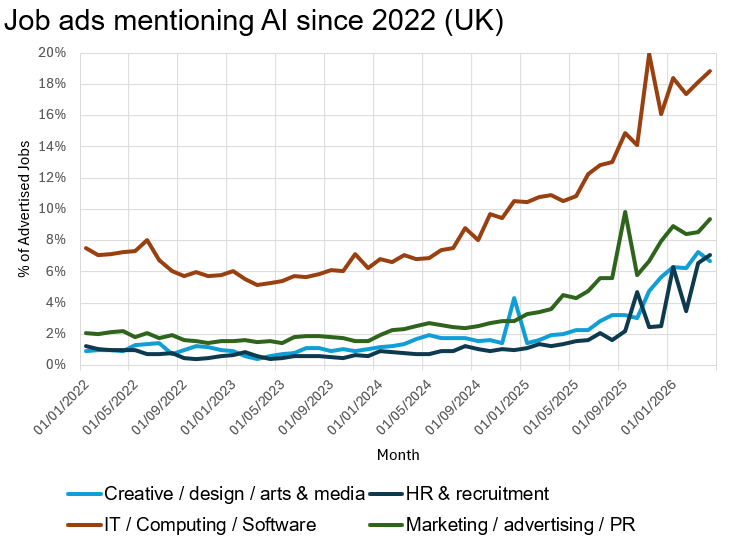
Nearly 1 in 10 UK marketing job ads now mentions AI. A year ago, it was fewer than 1 in 50.
That single data point captures something significant happening in the UK job market right now – and it has very little to do with software engineers or Silicon Valley. AI fluency is spreading fast into marketing teams, HR departments, sales floors and admin roles across every corner of the UK economy.
We know this because we’ve been watching it happen, in real time, across millions of job listings on Adzuna.
Today we’re launching the Adzuna AI Mentions Index: a monthly tracker of how employers are writing AI into their hiring requirements, sector by sector, across the UK and US.
What the data shows
The headline number: 2.3% of all UK job ads now mention AI – nearly double the rate of 15 months ago. In absolute terms, that’s 18,000 UK job ads every month referencing AI tools or AI fluency, up from around 9,500 a year ago.
That growth is happening while overall UK hiring has cooled. Total job listings on Adzuna have fallen around 14% over the same period. More jobs are requiring AI skills. Fewer jobs are being advertised overall. The two trends together tell you something important about where the job market is heading.
The sectors moving fastest – and it’s not IT
The most common assumption about AI and jobs is that it’s primarily a technology sector story. The data says otherwise.
- Marketing, advertising and PR has seen its AI mention rate grow 4.8 times since January 2024 – from 2.0% of all marketing job ads to 9.4% in April 2026. That rate of growth is faster than IT and computing (2.8x over the same period), despite tech roles starting from a much higher base. Right now, nearly 1 in 10 UK marketing job ads mentions AI.
- HR and recruitment tells an even sharper story. The sector responsible for hiring is itself being reshaped by the tools it deploys. AI mention rates in HR job ads have grown 7.8 times since January 2024 – from 0.9% to 7.1%. More than 1 in 14 UK HR job ads now mentions AI fluency as a requirement.
- Admin and clerical roles have seen AI requirements grow 15 times since 2022 – from 0.16% to 2.26% of all ads. These roles have long been identified as most exposed to automation. The data now shows employers actively specifying AI skills in these listings, which is a meaningful shift.
- Sales is also moving quietly but consistently – now at 3.2% of job ads, with nearly 1,000 AI-mentioning listings per month.
IT and computing remains the sector with the highest AI mention rate by some distance – 18.9% of UK tech job ads mention AI. But it’s no longer where the growth is concentrated. The story has moved.
Why did this happen now?
The timing of the acceleration is worth understanding. ChatGPT launched in November 2022 and entered mainstream awareness almost immediately. Yet our data shows the overall UK AI mention rate was broadly flat through 2023 and into 2024 – before rising sharply from mid-2025 onwards.
That’s roughly an 18-month lag between widespread tool adoption and those tools appearing as requirements in job specifications. Employers needed to experience AI, integrate it into workflows, and then start expecting it from the people they hire.
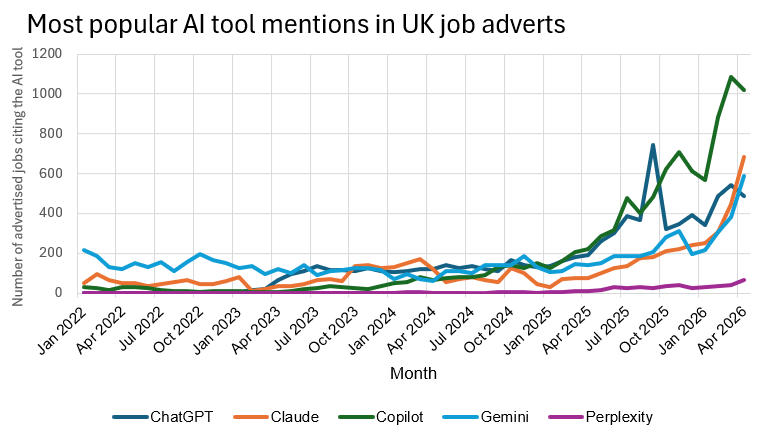
The data also points to enterprise deployment as a key driver. The fastest-growing named tool in UK job ads isn’t ChatGPT – it’s Microsoft Copilot, which reflects large-scale enterprise rollouts that embed AI tool use across entire workforces. When a company deploys Copilot across thousands of employees, it starts showing up in job specs at scale. That’s a different dynamic from individual consumer adoption.
The UK is catching up with the US – fast
The US has had consistently higher AI mention rates throughout the period we’ve tracked – 3.4% in April 2026 compared to 2.3% in the UK. But the more telling comparison is the rate of change.
In 2025, UK AI mention growth accelerated 46% year on year. US growth over the same period: 0%. The gap between the two markets is closing quickly, which suggests the UK employer base is now moving through the same adoption curve the US went through a year earlier.
What this means for job seekers
Every major technology shift creates anxiety, and AI is no different. But our data tells a more nuanced story: employers aren’t just replacing skills, they’re seeking new ones – and fast.
A marketing professional who is comfortable with AI tools today is more employable than one who isn’t. The same is true in HR, sales, admin, and finance. The question for UK workers is no longer whether AI will affect their sector. It already has.
As our co-founder Andrew Hunter puts it: “The roles changing fastest aren’t in Silicon Valley or Shoreditch’s tech hubs. They’re in marketing teams, HR departments, and sales floors up and down the country. Job seekers who get comfortable with these tools now won’t just keep up. They’ll get ahead.”
If you want to understand what AI skills employers in your sector are actually asking for – and find the roles where those skills are valued – search on Adzuna.
Methodology
The Adzuna AI Mentions Index tracks the proportion of UK (and US) job listings that contain references to artificial intelligence, large language models, or named AI tools including ChatGPT, Microsoft Copilot, GitHub Copilot, Google Gemini, Anthropic Claude and Perplexity. Data is drawn from Adzuna’s full job listing database and reported monthly by job category.
Category-level figures are only included where average monthly AI mentions exceed 30 – below this threshold, month-to-month volatility makes percentage figures unreliable. Copilot mentions combine Microsoft 365 Copilot and GitHub Copilot, which are separate products; this reflects Microsoft’s broad enterprise deployment rather than a single tool’s adoption. All figures are proportions of total job listings within each category.
The Adzuna AI Mentions Index publishes monthly. For press enquiries or data requests, contact simond@adzuna.com.