Our April 2026 UK Job Market Report shows that vacancies are recovering, pay is still rising, and despite applications per role increasing, time to fill is also creeping up. For TA leaders, the bottleneck has shifted: it’s no longer attracting candidates, it’s identifying the right ones quickly enough to hire them.
The full report covers the macro picture; this blog tells you what to do about it.
What the latest UK hiring trends mean for TA teams
Time to hire is rising
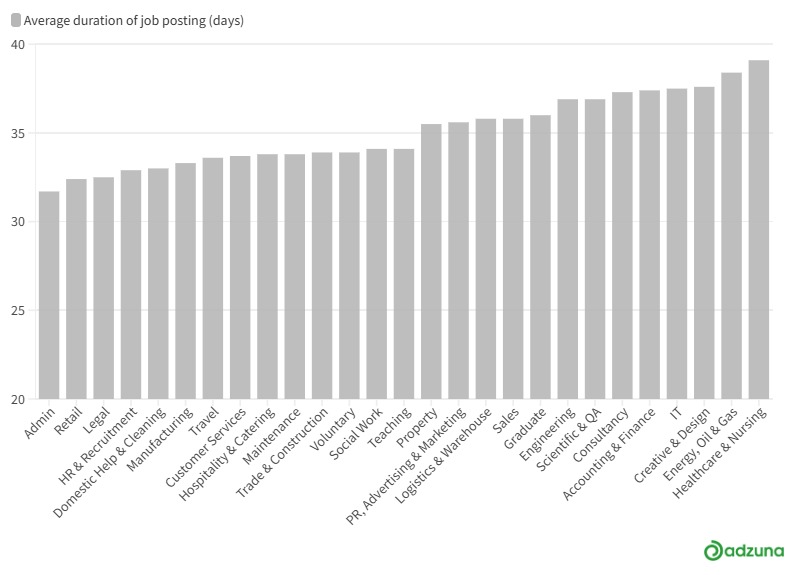
The average role now takes 39.5 days to fill, up from 34.9 days a month ago. Healthcare & Nursing (39.1 days), Energy, Oil & Gas (38.4 days) and IT (37.5 days) are the slowest. Admin (31.7 days), Retail (32.4 days) and Legal (32.5 days) move fastest. Now may be the ideal time to engage passive candidates, which can reduce time to fill by up to 65%.
Candidates per role has increased
Jobseekers per vacancy sits at 2.29 nationally, up sharply from 1.81 a year ago. Power has shifted toward employers in every region except the South West (1.64), South East (1.65) and Eastern England (1.90).
The challenge for TA leaders is no longer just attracting applicants, but identifying the right talent as application volumes rise. Ensuring your sourcing partners deliver quality over quantity has never been more important.
Vacancies are recovering, slowly
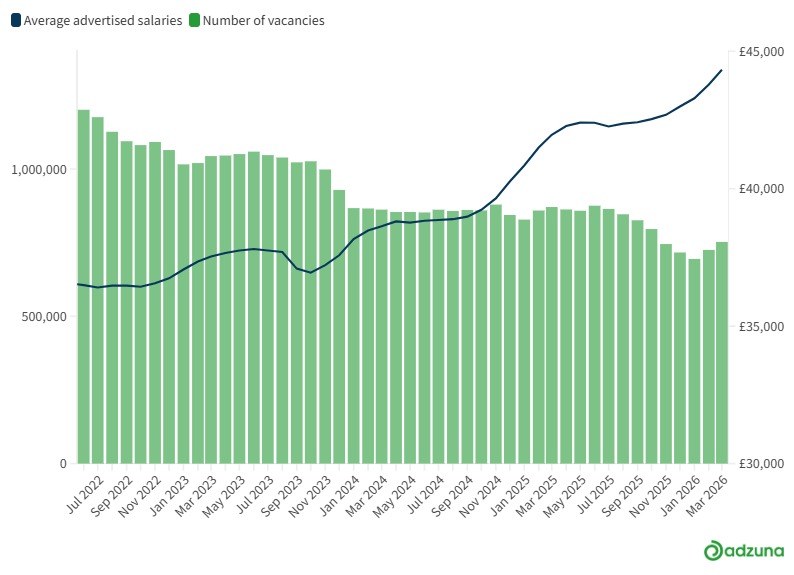
752,711 roles were advertised in March, up 3.74% on February but still 13.60% below this time last year. Businesses that maintain hiring momentum now may outperform competitors when demand accelerates further.
Pay is still climbing
Average advertised salary hit £44,031, up 4.90% year on year and ahead of inflation. London crossed £50,000 for the first time. IT leads at £65,347, up 13.50%. Only 4 sectors saw salaries fall: Maintenance, Travel, Social Work, Creative & Design. Use granular data to benchmark your salaries to ensure your roles are competitive.
Transparency is slipping
Only 43.74% of UK job ads now include salary, down from 45.72% in February. That may be harming your conversion rates whether you realise it or not. With many TA teams reporting an increase in application volumes, including salary information can help reduce wasted time engaging candidates whose expectations are misaligned from the outset, improving both hiring efficiency and candidate quality.
Competition for frontline staff is increasing
Teaching vacancies passed 210,000 in March, 28.40% higher than a year ago, with average pay of £37,309. Domestic Help & Cleaning vacancies surged 118.76% year on year. These are the sectors where employers are competing hardest right now.
Graduate pools are strong
Graduate roles fell 34.90% year on year to 10,667, while graduate output from universities hasn’t fallen. If you’re running a graduate scheme, the market is tilted in your favour: more applicants per place, stronger pools to choose from, less pressure to increase starting salaries.
Entry-level non-graduate vacancies hit a record 225,634 in March. With 957,000 young people not in education, employment or training, there’s a sizable, underserved candidate pool sitting outside the traditional graduate channel. This is worth paying attention to if entry-level hiring is part of your 2026 plan.
3 moves to make in response to these talent acquisition trends
Reduce time to fill by engaging passive candidates
Time to fill jumped almost 5 days month on month. If you’re forecasting Q3 hires, you may need to add a fortnight of slack to your plan, particularly in Healthcare, Energy and IT. For frontline roles in Teaching, Domestic Help and Cleaning, where vacancies are up sharply, the candidate pool is thinner than the headline jobseeker-per-vacancy figure suggests. Engaging passive candidates via social media sourcing is an effective way to reduce time to fill by up to 65%.
Re-benchmark your offers before you re-open requisitions
Salaries are up nearly 5% year on year. If you’re working from a comp band set in late 2024, you’re underbidding the market and your time-to-fill will tell the story. Sector-level moves vary widely, so benchmark by role, sector and region, not by national average.
Put salary on your job ads
In a recent poll, an overwhelming 73% of respondents voted that the lack of salary information was their biggest turnoff in job advertisements. Adzuna data shows job ads that include salary information receive 2x more clicks and generate up to 6 times more applications.
With candidates per vacancy rising and time to fill increasing, salary transparency doesn’t just boost engagement, it also filters out mismatched applications earlier, saving recruiters some much needed time.
With 56% of ads now missing pay information, including yours puts you ahead of the majority. It’s one of the simplest and highest-impact ways to improve attraction, conversion and hiring efficiency this quarter.
Where this data goes deeper
Sector and regional averages will get you part of the way. To benchmark a specific role, in a specific location, against a specific competitor set, you need granular data:
- Salary benchmarking by job title, sector and region: go beyond the national average
- Employer competition: see how hard the market is fighting for the same candidates as you
- Skills demand trends: track which skills are appearing and disappearing from adverts in your sector
Email tessa@adzuna.com to get your tailored hiring market report and see exactly how your roles stack up, plus the insights you need to hire faster and more competitively.