
UK Job Market Report
18 December 2023


Adzuna has the most complete index of UK job vacancies covering all regions in the UK, based on every job vacancy advertised online in the UK from over 1,000 sources. This data is then normalised, de-duplicated, mix-adjusted and outliers are removed in real time to give an accurate, complete, up to the minute view of the job market. Our UK Job Market Report tracks advertised vacancies, average advertised salaries, competition for jobs, trending roles, time to fill positions, and more.
We also supply real-time data to the Number 10 Dashboard, the Cabinet Office and the Office for National Statistics’ labour market indices. For more granular data breakdowns at a local authority level, job title, or skill level, please contact our labour market intelligence division, Adzuna Intelligence.
Vacancies
The number of job vacancies available in November dropped below 1 million for the first time this year – the lowest level they’ve been since May 2021.
Suggesting a significant dive in company confidence, advertised vacancies fell -2.7% between October and November to just 998,562 postings, down -8.6% decline compared to the same time last year and the first time during 2023 that the annual decline has worsened, month-on-month. October’s year-on-year figures were -5.1% down on 2022’s numbers.

Salaries
While falling vacancies suggest a stalling in the UK’s jobs market, advertised salaries are on the rise again – for the first time since June. They were up +0.7% in November, compared to October’s figures, and up +1.8% compared to the same time last year, with November 2023 seeing average advertised salaries of £37,221.
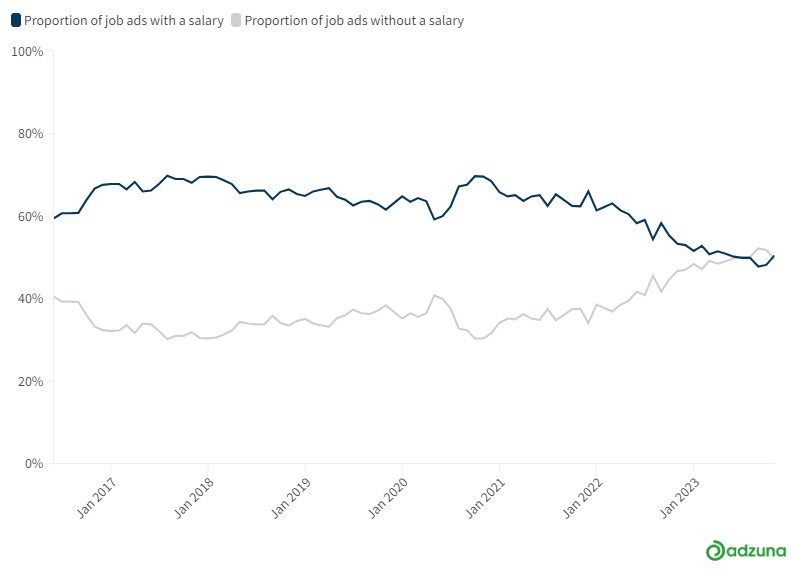
Salary transparency is also improving, with more jobs advertising salaries in November (50.5% compared to 49.5% without) for the first time since July.
Time to fill
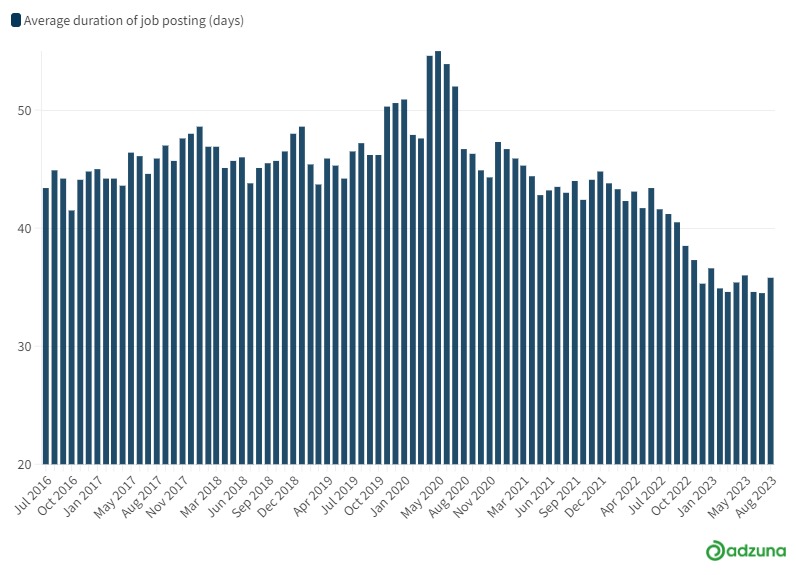
The average time to fill vacancies has risen to its highest level in three months, at 35.8 days on average in August 2023, up from 34.5 in July, but still below the 41.2 days seen in August 2022.
Competition
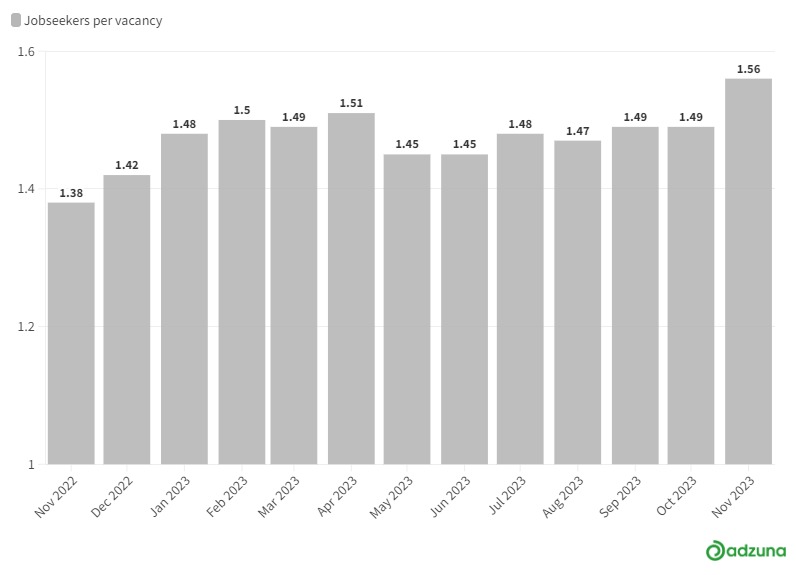
The number of jobseekers per vacancy has increased to 1.56 in November, the highest level seen this year, and up from 1.49 in October.
Hottest cities
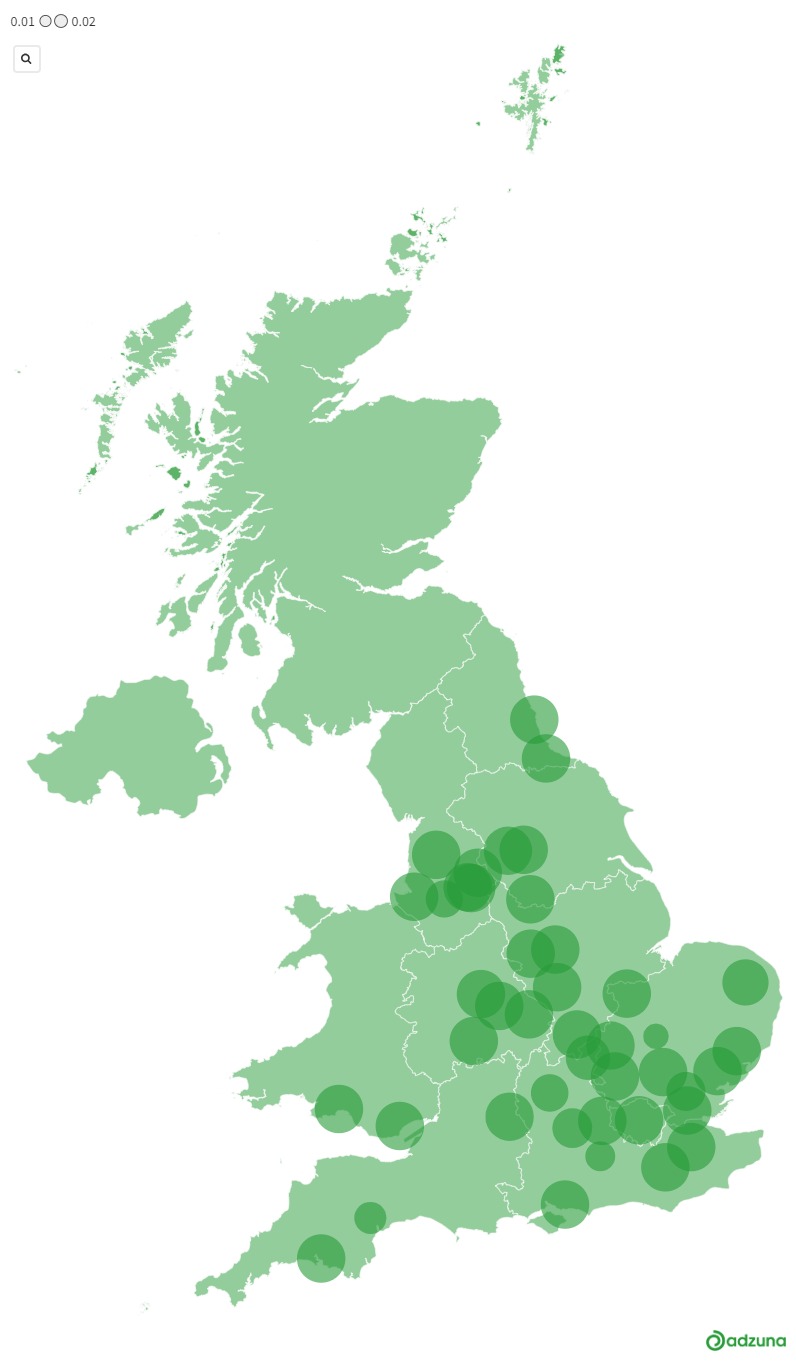
For the past year, Cambridge has been the top city for those looking for a new role. On average, there have been 0.26 jobseekers for every job in the city, competing for around 9,000 jobs, though this has increased slightly in November to 0.28 jobseekers for 8,396 jobs.
Bradford continues to be one of the hardest places to find a job with some of the toughest competition. Throughout 2023, there have been around 5.77 jobseekers competing for around 3,000 available jobs.
UK regions
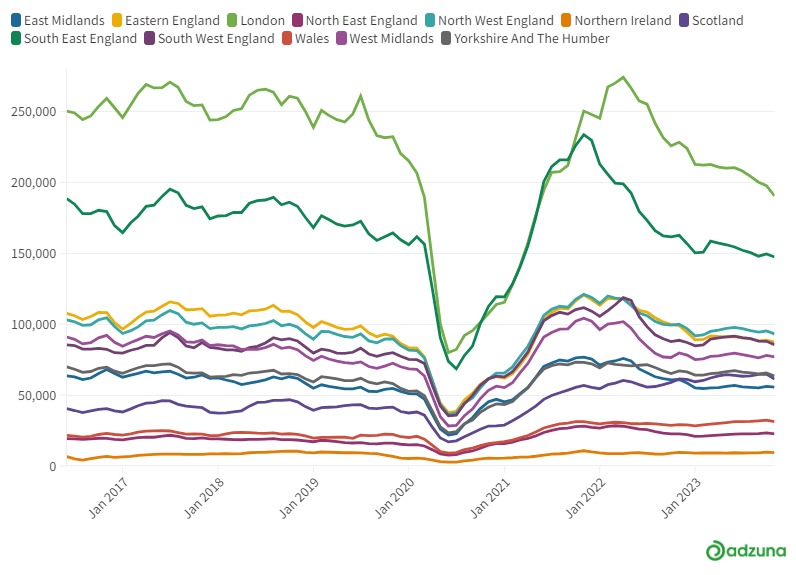
Wales continues as the region with the strongest annual growth in advertised vacancies, up +7.3% year-on-year to 31,286 in November, though hiring has slowed slightly month-on-month. London has seen the largest annual decline, with 190,462 advertised vacancies in November 2023, down -16.6% year-on-year.
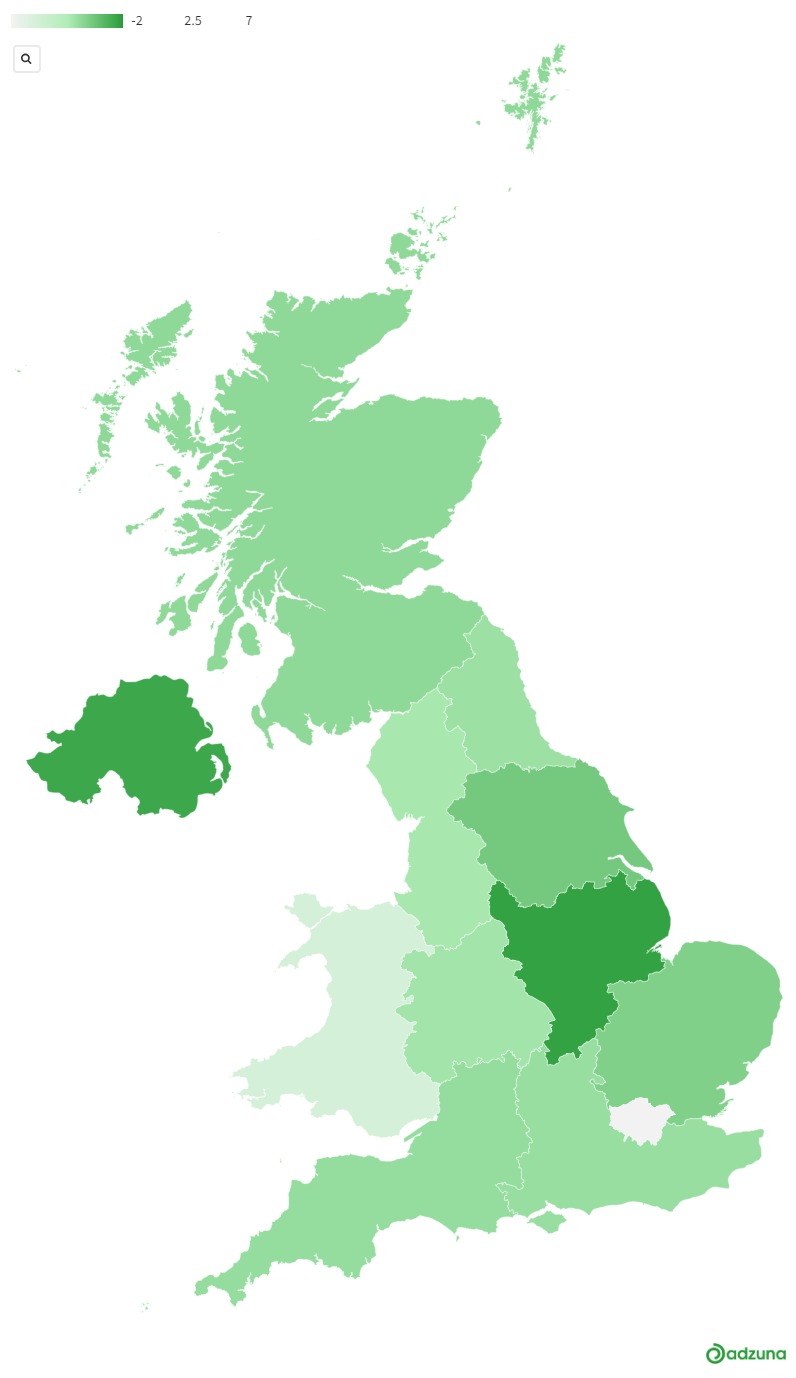
London continues to be the only region in the UK seeing annual declines in average advertised salaries, down -2.0% in November. After Wales experienced a fall in October, it saw slight growth last month, up +0.03%.
East Midlands saw the highest year-on-year growth in November, overtaking Northern Ireland and Yorkshire And The Humber which have been consistently two of the top regions for salary growth throughout 2023. This growth in the East Midlands has been driven by an increase in average salaries in Leicester, up +6.8% to £34,781.
UK sectors
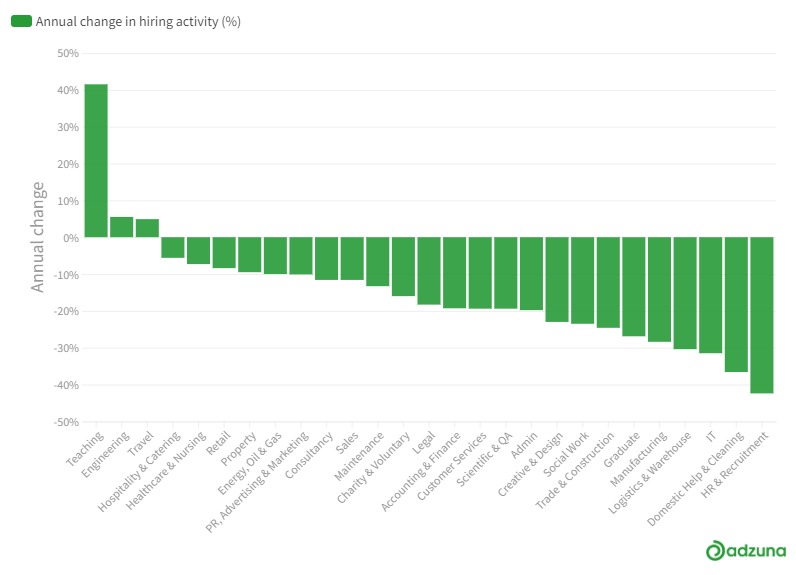
November saw the highest year-on-year increase in teaching roles, up +41.5% on November 2022. This is representative of the wider 2023 trends seen in the education sector. Teaching has been the largest recruiting sector on Adzuna throughout 2023. At its highest level, in June, there were 120,000 teaching vacancies, up +34.1% from June 2022. The average advertised salary also hit its highest in June, reaching £31,695.
Other sectors have experienced fluctuating demand in 2023. HR & Recruitment and Graduate recruiting, in particular, have had a difficult year. HR & Recruitment jobs have been consistently falling month on month since January when jobs fell -14.5% compared to the month before, with June the only month to post positive growth (+1.2%). In November, available jobs in HR & Recruitment were down by -42.5% compared to a year before.
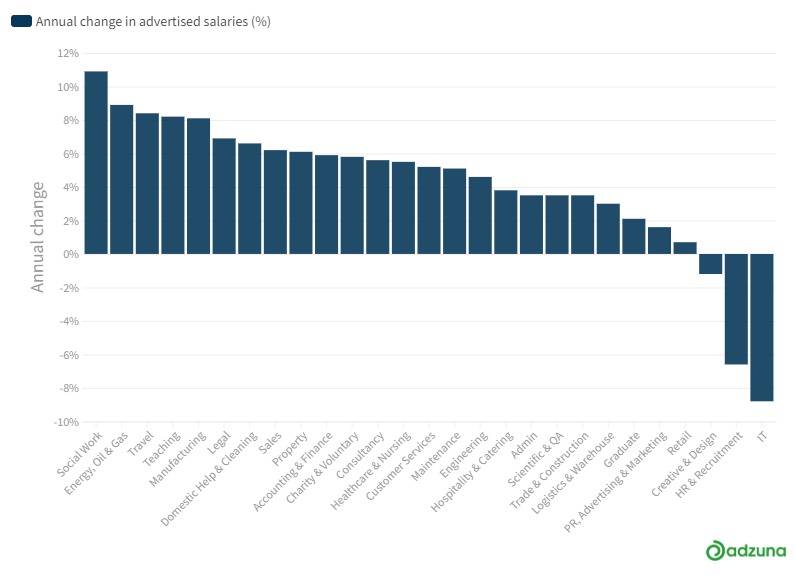
As the overall average advertised salary increased in November, there were small increases in remuneration compared to October for nearly all sectors including Domestic Help & Cleaning (+0.8%), Hospitality & Catering (+0.9%) and Property (+1.5%). Compared to November 2022, Social Work has experienced the biggest annual increase in advertised salaries, up +10.9% to £33,767, followed by Energy, Oil and Gas (+9.0% to £44,210) and Manufacturing (+8.1% to £29,160).
Yet the highest average salaries can be found in the Legal sector (£54,633, an increase of +6.9%), and IT (£51,284), despite the fact IT salaries are down -8.8% compared to November 2022.
On the other hand, salaries have been sluggish in HR & Recruitment, with advertised salaries down -6.6% to £38,122 in November, compared to the same time last year. Creative & Design is also down by -1.2% to an average of £38,288.
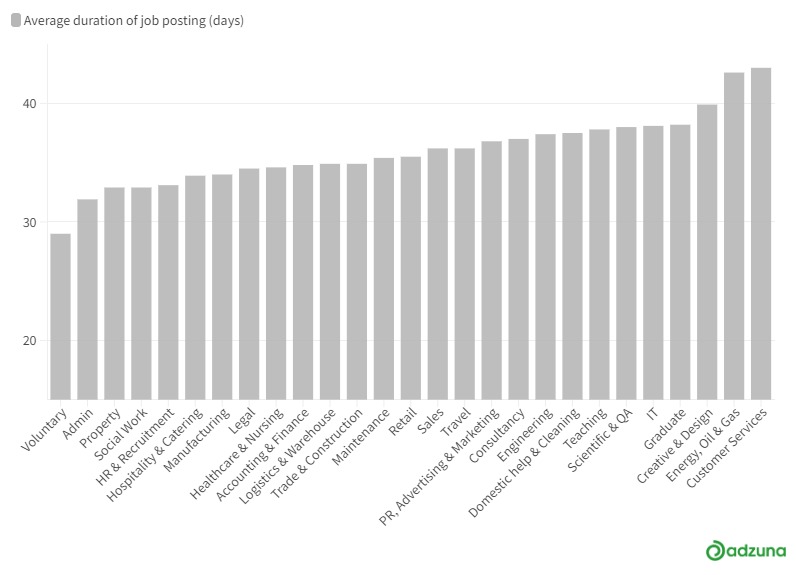
Looking at the latest data on the average duration of job ads for August 2023, jobs in the Admin sector take 31.9 days on average to fill, whilst it’s 32.9 for both Property and Social Work. Energy, Oil and Gas jobs take up to 42.6 days on average to fill and this sector has the smallest number of available roles (2,841) in November, speaking to the specialty of the skills needed.
Trending jobs
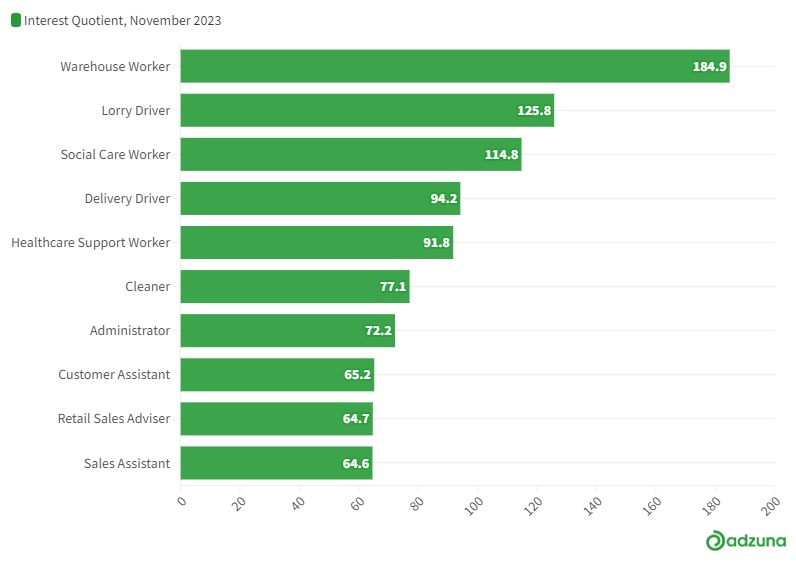
The data also tracks the most popular occupations among UK jobseekers. For the past six months, warehouse work has been the top trending job. Lorry driving roles also came second during the past six months, whilst Social Care Worker has also ranked highly throughout the year.
The data that Adzuna produce is an exceptionally rich and industry-leading source of real time insights into the labour market, local economies and what employers want. We’ve worked with the Adzuna team and their data across a range of projects, including labour market analysis, policy research and workforce planning and would highly recommend them.

Tony Wilson
Director
Institute for Employment Studies
Methodology
About Adzuna
Adzuna is a smarter, more transparent job search engine used by tens of millions of visitors per month. We love using the awesome power of technology to bring together every job in one place, help match people to better, more fulfilling jobs and keep Britain working.
Adzuna supplies real-time data to the Number 10 Dashboard, the Cabinet Office and Office for National Statistics labour market indices. In 2018, Adzuna won the contract to run Find a job, one of the British government’s most used online services.
Adzuna.co.uk was founded in 2011 by Andrew Hunter and Doug Monro, formerly of eBay, Gumtree, Qype and Zoopla and is backed by leading Venture Capital firms LocalGlobe, Index Ventures and Smedvig Capital.
We’ve spent a decade developing smarter, more transparent job search so jobseekers worldwide (we’re in 19 countries) can zero in on the right role faster.
About the Job Market Report
Adzuna has the most complete index of UK job vacancies covering all regions in the UK. The technology collects every job vacancy advertised online in the UK from over 1,000 sources. This data is then normalised, de-duplicated, mix-adjusted and outliers are removed in real time to give users an accurate, complete, up to the minute view of the job market.
Claimant count data is based on the latest Labour Market Statistics released by the ONS. The city areas referred to in this study are the top 50 cities in the UK, ranked by comparing the job vacancies in Adzuna’s comprehensive search index of over 1,000,000 live jobs to the number of claimants in each city from the latest ONS data. The full Jobseeker’s Allowance claimant count statistics are available for download here: www.nomisweb.co.uk.
The interest quotient for key roles is calculated by comparing how many views job postings for different occupations on Adzuna receive over a given month and comparing this to the overall job posting views over the same period. It provides a proxy for talent supply in the jobs market.
For more granular data breakdowns at a local authority level, job title, or skill level, please contact our labour market intelligence division, Adzuna Intelligence.