
UK Job Market Report
24 February 2025


Adzuna has the most complete index of UK job vacancies covering all regions in the UK, based on every job vacancy advertised online in the UK from over 1,000 sources. This data is then normalised, de-duplicated, mix-adjusted and outliers are removed in real time to give an accurate, complete, up to the minute view of the job market. Our UK Job Market Report tracks advertised vacancies, average advertised salaries, competition for jobs, trending roles, time to fill positions, and more.
We also supply real-time data to the Number 10 Dashboard, the Cabinet Office and the Office for National Statistics’ labour market indices. For more granular data breakdowns at a local authority level, job title, or skill level, please contact our labour market intelligence division, Adzuna Intelligence.
Vacancies
Job vacancies continued to trend downwards, with total numbers falling -1.86% month-on-month and -4.49% annually to 828,467 in January 2025, the lowest January figure since 2021.

Salaries
The average advertised annual salary continued to break records in January as it crept closer to the £41,000 mark. Significant salary jumps across Manufacturing and Maintenance roles pushed the UK average up +1.45% month-on-month but also saw salaries up +7.02% in January compared to this time last year. Salaries have outpaced inflation now for the past nine months.
Salary transparency continues to trend downwards, with more employers in the UK hiding salaries in job postings (53.92%) compared to those with (46.08%). This sees 2025 continue 2024’s run, where only one month in the whole year, February, had more jobs with salary information than without.

Time to fill
The average duration of job postings has increased from 34.1 days to 35.2 days.

Competition
The number of jobseekers per vacancy rose to 2.09 applicants per role in January 2025, up from 2.01 in December 2024.

Hottest cities
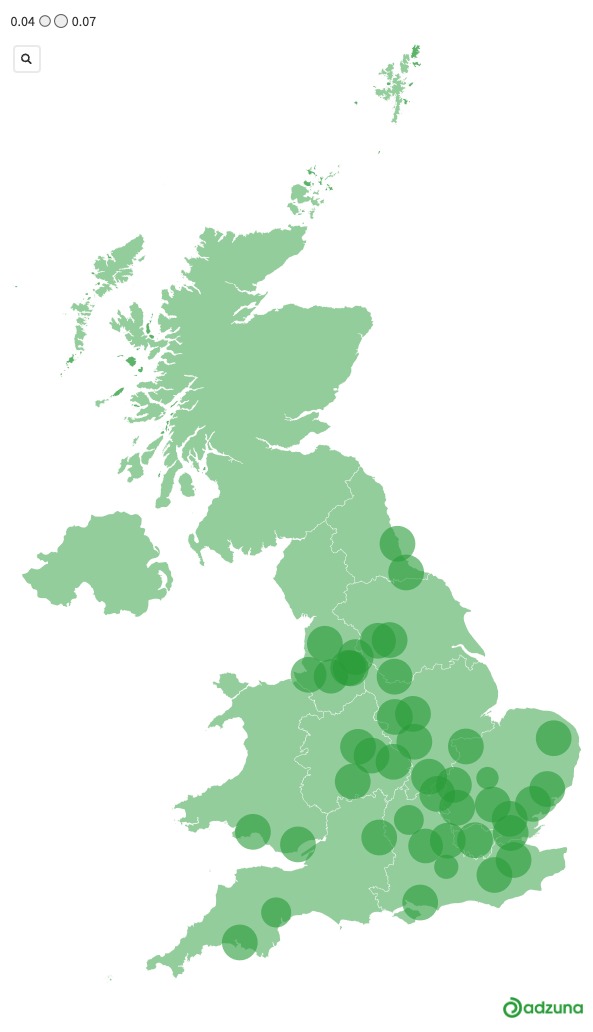
Cambridge remains the top city for job hunters, with the lowest jobseeker to available roles ratio at 0.4, with 6,677 roles available. Guildford comes second with 0.46 and Oxford third with 0.7.
The hardest city to find a role is Bradford, with 9.9 jobseekers per role, followed by Birmingham (5.31) and Luton (4.96).
UK regions
Advertised vacancies are down month-on-month in all regions except North East England, led by Northern Ireland (-4.62), Scotland (-4.32%), and South West England (-2.76%).
As vacancies continued to fall in January, the number of jobseekers per vacancy continued to rise to 2.09. This also saw jobseeker figures continue to rise across the regions. Only North East England saw no monthly change (+0.27%), and even then, it still has the highest number ratio at 3.61 jobseekers for every available vacancy.

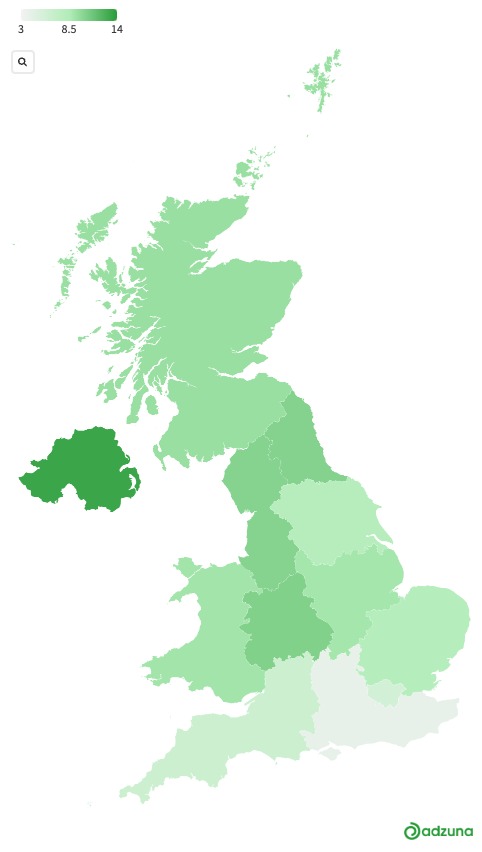
Advertised salaries continued to climb in the regions, with Northern Ireland once again experiencing the largest annual growth, +13.23%, followed by the West Midlands and North East England. London and South East England continue to be at the bottom end of the table with +5.68% and +3.89% growth respectively.
UK sectors
Of the 27 sectors tracked in the Adzuna report, 21 saw monthly vacancy numbers drop in January. Among the worst hit were Retail, falling -16.23% in January after having already fallen -19.01% in December. This was joined by declines in Travel (-12.84%) and Logistics and Warehouse roles (-12.77%).
Helping to stem the decrease in monthly jobs, Trade & Construction continued to see vacancies increase in January, up +12.12%, demonstrating an increase in construction productivity in line with Deputy PM Angela Rayner’s housing plan to build 1.5 million new homes and Admin roles, up +2.47%. Teaching saw yet another month of growth, with roles now exceeding 156,000, however, with a monthly rise of just +0.28%, hiring appears to be plateauing.
In terms of annual growth, eight sectors saw yearly vacancy increases, led by Teaching (+33.94%), Trade and Construction (+22.87%) and Legal (+10.69%). However, the majority of sectors saw annual declines, with Retail dipping the most (-42.25%), followed by PR, Advertising & Marketing (-38.36%), Energy, Oil & Gas (-35.43%) and Graduate (-21%).

The surge in the UK’s average advertised salary to £40,846 continues to break records, thanks to an increase in salaries for key sectors, including Manufacturing, Retail and Maintenance. Maintenance salaries rose +2.24% month-on-month and +19.09% year-on-year, whilst Retail increased +2.35% and +14.47%, respectively. Manufacturing experienced a +2.35% monthly increase in salaries and +10.35% annually. Other sectors with substantial annual increases include Logistics & Warehouse (+17.72%), Customer Service (+12.97%) and Domestic Help & Cleaning (+11.75%). Annual private sector wage growth also continues to outstrip the public sector, up +6.2% compared to 4.7%, respectively.
Only Energy, Oil & Gas jobs experienced a month-by-month fall in average salary, down -3%. At the same time, Legal was once again the only sector to see a dip in average salaries on an annual basis, down -2.55% compared to January 2024.

Legal remains the sector with the shortest time to fill jobs at 31.4 days, followed by Admin (32 days). Conversely, Domestic Help & Cleaning jobs now take an average of 49.2 days to fill, up from 38.7, while Healthcare & Nursing also tipped over the 40-day mark.

Trending jobs
Healthcare Support Worker holds firm in the number one spot as the most in-demand role on Adzuna’s Trending Roles list. This metric ranks occupations based on their Interest Quotient, which measures how often job postings are viewed relative to other roles. A higher quotient indicates greater demand among jobseekers.
After sitting in second place in December 2024, Warehouse Worker fell into third, overtaken by Social Care Worker. Sales Assistant has dropped two places from fourth to sixth, having been overtaken by Cleaner and Retail Sales Adviser.

Methodology
About Adzuna
Adzuna is a smarter, more transparent job search engine used by tens of millions of visitors per month. We love using the awesome power of technology to bring together every job in one place, help match people to better, more fulfilling jobs and keep Britain working.
Adzuna supplies real-time data to the Number 10 Dashboard, the Cabinet Office and Office for National Statistics labour market indices. In 2018, Adzuna won the contract to run Find a job, one of the British government’s most used online services.
Adzuna.co.uk was founded in 2011 by Andrew Hunter and Doug Monro, formerly of eBay, Gumtree, Qype and Zoopla and is backed by leading Venture Capital firms LocalGlobe, Index Ventures and Smedvig Capital.
We’ve spent a decade developing smarter, more transparent job search so jobseekers worldwide (we’re in 19 countries) can zero in on the right role faster.
About the Job Market Report
Adzuna has the most complete index of UK job vacancies covering all regions in the UK. The technology collects every job vacancy advertised online in the UK from over 1,000 sources. This data is then normalised, de-duplicated, mix-adjusted and outliers are removed in real time to give users an accurate, complete, up to the minute view of the job market.
Claimant count data is based on the latest Labour Market Statistics released by the ONS. The city areas referred to in this study are the top 50 cities in the UK, ranked by comparing the job vacancies in Adzuna’s comprehensive search index of over 1,000,000 live jobs to the number of claimants in each city from the latest ONS data. The full Jobseeker’s Allowance claimant count statistics are available for download here: www.nomisweb.co.uk.
The interest quotient for key roles is calculated by comparing how many views job postings for different occupations on Adzuna receive over a given month and comparing this to the overall job posting views over the same period. It provides a proxy for talent supply in the jobs market.
For more granular data breakdowns at a local authority level, job title, or skill level, please contact our labour market intelligence division, Adzuna Intelligence.