
UK Job Market Report
26 February 2024


Adzuna has the most complete index of UK job vacancies covering all regions in the UK, based on every job vacancy advertised online in the UK from over 1,000 sources. This data is then normalised, de-duplicated, mix-adjusted and outliers are removed in real time to give an accurate, complete, up to the minute view of the job market. Our UK Job Market Report tracks advertised vacancies, average advertised salaries, competition for jobs, trending roles, time to fill positions, and more.
We also supply real-time data to the Number 10 Dashboard, the Cabinet Office and the Office for National Statistics’ labour market indices. For more granular data breakdowns at a local authority level, job title, or skill level, please contact our labour market intelligence division, Adzuna Intelligence.
Vacancies
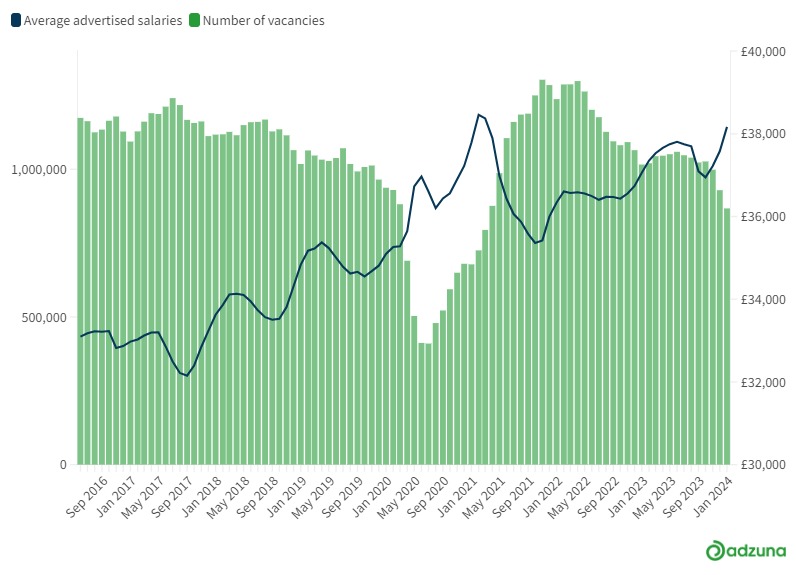
Job vacancies in the UK have fallen below 900,000 for the first time since April 2021 as companies continue to slow down hiring plans.
Advertised job vacancies fell to 867,436 in January 2024. This represents both a year-on-year decline of -14.6%, compared to 1,016,000 in January 2023, and a month-on-month drop of -6.6% compared to 929,138 in December.
Salaries
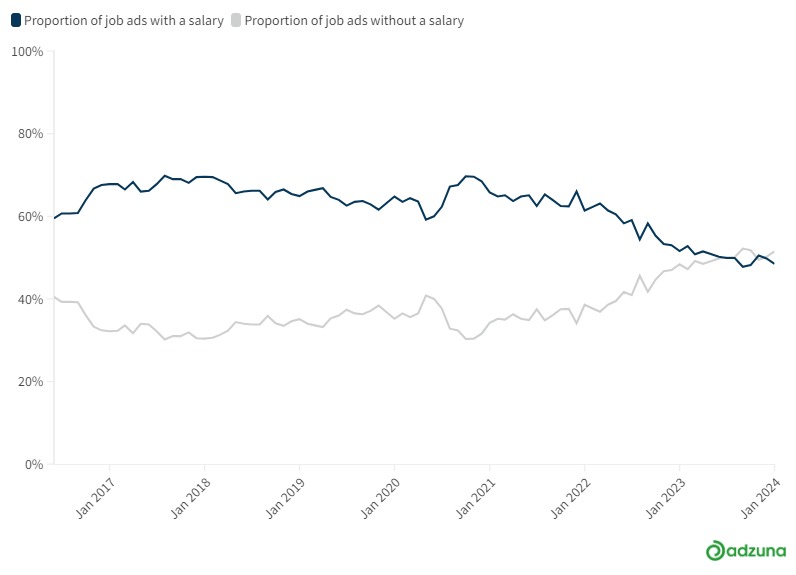
Average advertised salaries increased again in January, continuing the upward trajectory seen in December. National salaries were up +1.6% monthly to £38,168 last month, +3.0% higher than in January 2023, the highest they’ve been since March 2021.
However, it’s becoming increasingly difficult to track average salaries in the UK, with over half of positions (51.5%) advertised without salaries, in a continued blow to salary transparency campaigners.
Time to fill
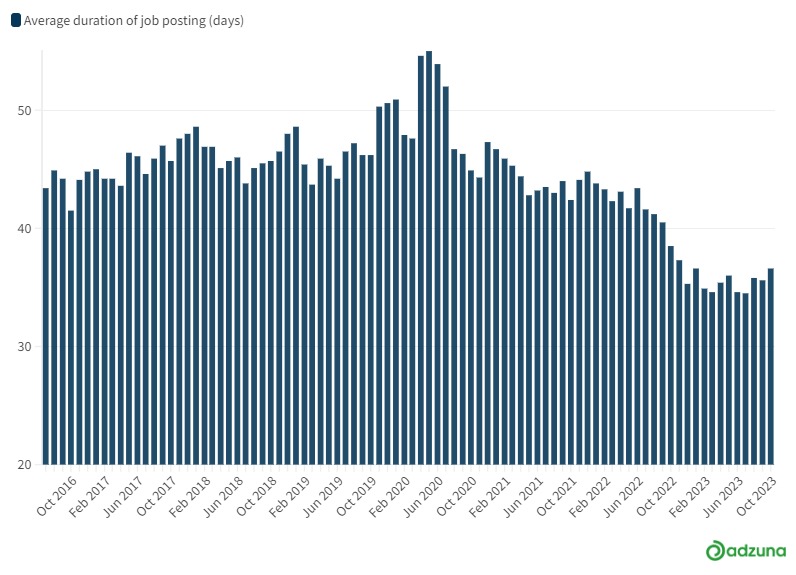
Companies are taking longer to make decisions about new team members, perhaps in response to the reduction in hiring budgets. Advertised vacancies were live on average for 36.6 days before being filled in October 2023 (the latest data), up from 35.6 in September and the longest time-to-fill since January 2023.
Competition
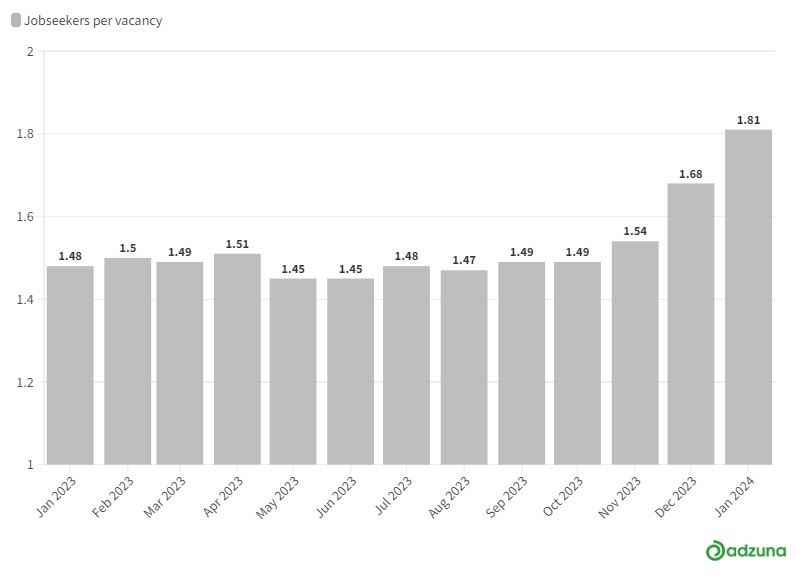
The contraction in vacancies means that competition for those posts available is increasing, up to 1.81 jobseekers per vacancy in January 2024 from 1.68 a month earlier. This is the highest competition rate since August 2021, the last time there was 1.81 people for every available role.
Hottest cities
As vacancies continue to fall, the competition for jobs is increasing. Yet in certain cities across the UK – Cambridge (0.3 jobseekers per available roles), Oxford (0.7) and Reading (0.79) – there continues to be a surplus number of jobs compared to jobseekers.
In cities where there are more jobseekers than available roles such as Bradford (7.17), Birmingham (3.9) and Sunderland (3.3), competition is continuing to rise, making it harder for those looking to find suitable work.

UK regions
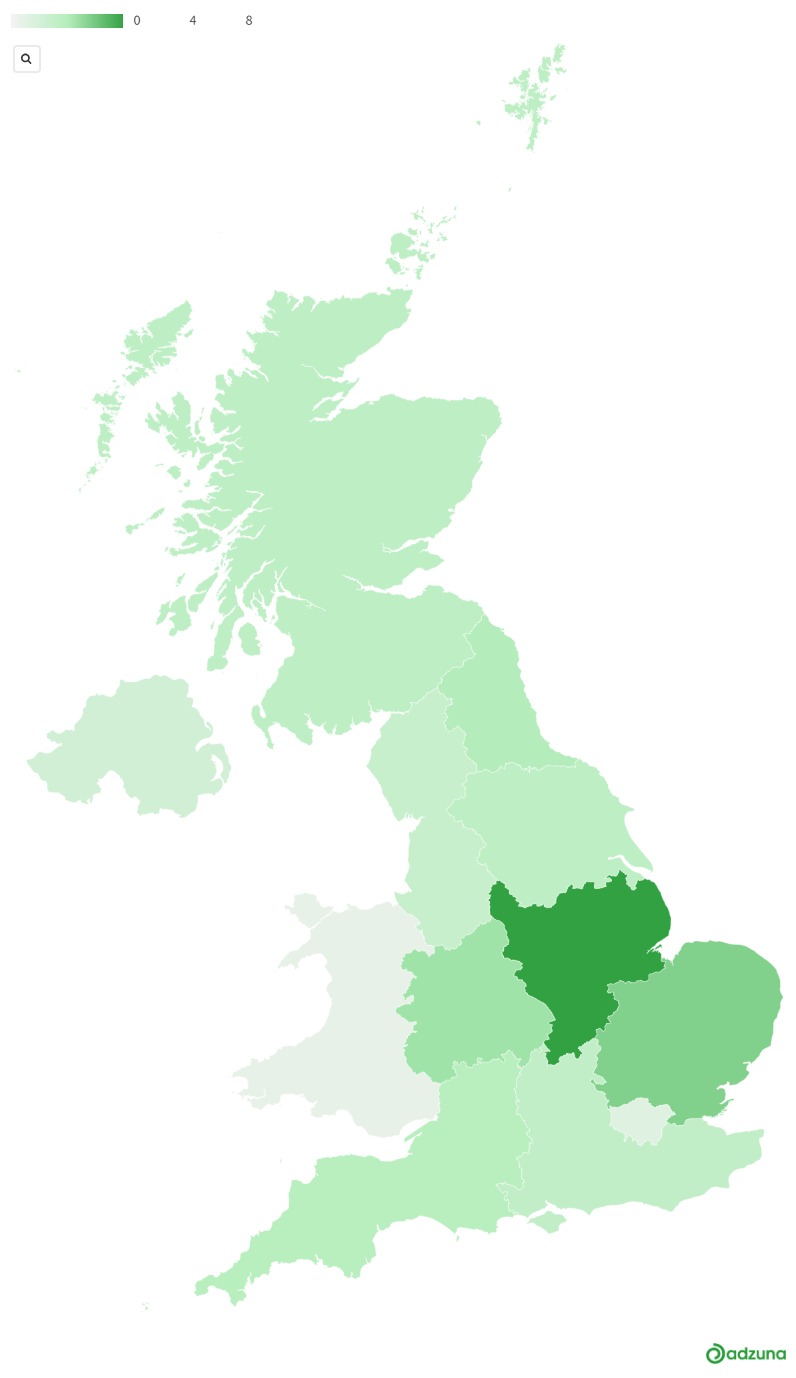
Advertised vacancies continued to fall month-on-month in every UK region in January 2024, led by the West Midlands (-7.7%), London (-7.4%), and Scotland (-7.3%). By comparison, vacancies held up best in Wales (-4.9%).
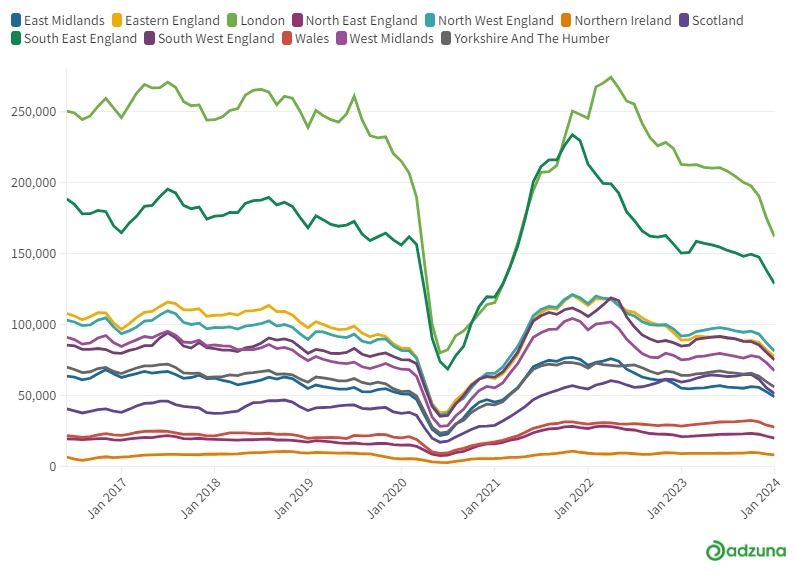
After years of steady regional salary declines, average advertised annual salaries in London rose by +1.23% to £44,399 in January – the first increase since November 2022. East Midlands came top for the second month in a row in January with the highest annual growth in salaries (+7.68%), followed by Eastern England (+5.4%).
Northern Ireland has slumped further down the table, experiencing +2.09% annual growth in January, down from the +2.81% the month before.
UK sectors
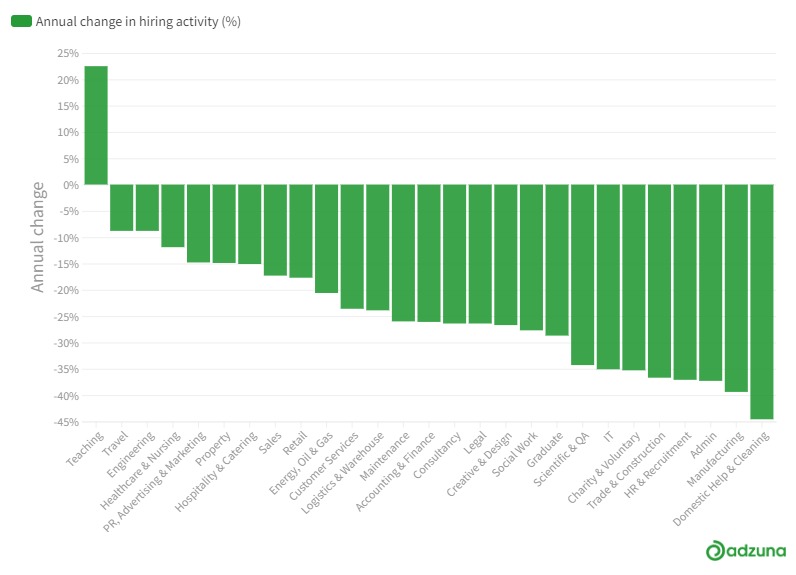
Every single one of the 26 sectors we track experienced a monthly fall in hiring in January 2024, including Teaching, the only job sector to post positive growth last month, which saw a -5.9% drop. The smallest declines were experienced by PR, Advertising and Marketing (-2.8%) and Energy, Oil and Gas (-3.4%), compared to December 2023, whilst the biggest decrease was in Manufacturing (-18.0%).
On an annual basis, however, Teaching continued to be the only sector to record growth in vacancies, with roles up +22.5% compared to January 2023. The smallest annual fall in roles was in Travel (-8.8%) and Engineering (-8.8%), whilst the biggest annual decrease was in Domestic Help and Cleaning, with the industry nearly halving (-44.6%).
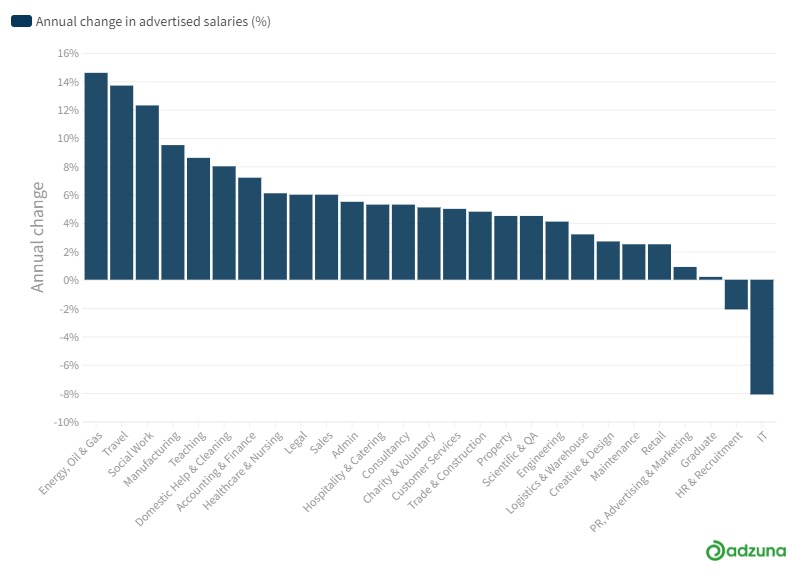
As with the general trend seen with salaries last month, the majority of industries saw an increase in average advertised salaries on both a monthly and annual basis. Salaries for Retail roles increased +3.5% compared to December, while Admin salaries rose +2.3%. The biggest annual increases in salaries were for Energy, Oil and Gas (+14.6%) and Travel (13.6%).
Only three sectors experienced a slight fall in salary month-on-month: PR, Advertising and Marketing (-0.2%), Graduate (-0.5%) and Consultancy (-0.6%), and only two sectors saw an annual drop: IT (-8.1%) and HR and Recruitment (-2.1%).
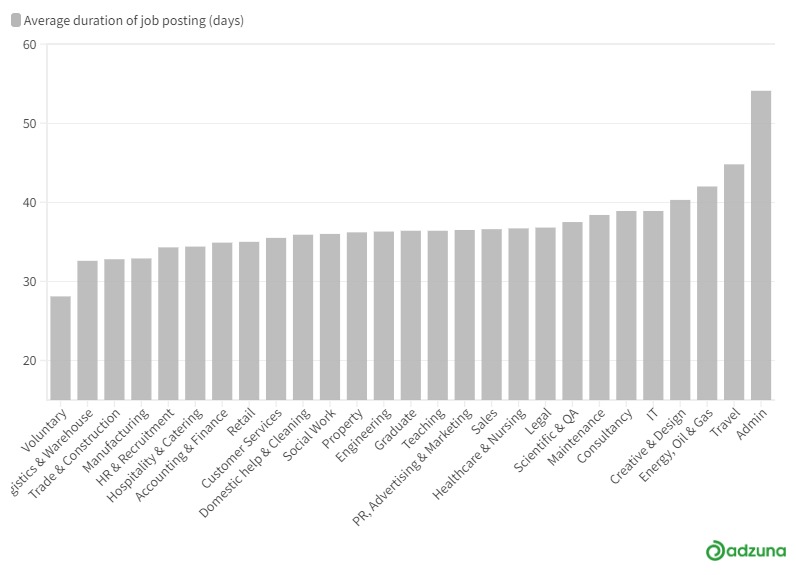
Admin jobs took the longest time to fill at 54.1 days on average, followed by Travel (44.8) and Energy Oil & Gas (42.0). Voluntary roles are filling fastest at just 28.1 days.
Trending jobs
The data also tracks the most popular occupations among UK jobseekers. Warehouse work continues to be the top trending job for the eighth month in a row.
For the past few months Lorry Driving roles have come second, yet this month it has slumped to ninth place, following a -35.9% fall in advertised vacancies. This role is driven by seasonal trends, often peaking between October to December ahead of Christmas hiring, so it’s not unusual for available roles to fall after this point. However, annual hiring is down -53.3% compared to January 2023, suggesting a slower start to 2024 which may explain why there is less demand from job hunters for this role.
Healthcare Support work has risen to second position, meanwhile, Social Care work continues to be the third-most trending job.

The data that Adzuna produce is an exceptionally rich and industry-leading source of real time insights into the labour market, local economies and what employers want. We’ve worked with the Adzuna team and their data across a range of projects, including labour market analysis, policy research and workforce planning and would highly recommend them.

Tony Wilson
Director
Institute for Employment Studies
Methodology
About Adzuna
Adzuna is a smarter, more transparent job search engine used by tens of millions of visitors per month. We love using the awesome power of technology to bring together every job in one place, help match people to better, more fulfilling jobs and keep Britain working.
Adzuna supplies real-time data to the Number 10 Dashboard, the Cabinet Office and Office for National Statistics labour market indices. In 2018, Adzuna won the contract to run Find a job, one of the British government’s most used online services.
Adzuna.co.uk was founded in 2011 by Andrew Hunter and Doug Monro, formerly of eBay, Gumtree, Qype and Zoopla and is backed by leading Venture Capital firms LocalGlobe, Index Ventures and Smedvig Capital.
We’ve spent a decade developing smarter, more transparent job search so jobseekers worldwide (we’re in 19 countries) can zero in on the right role faster.
About the Job Market Report
Adzuna has the most complete index of UK job vacancies covering all regions in the UK. The technology collects every job vacancy advertised online in the UK from over 1,000 sources. This data is then normalised, de-duplicated, mix-adjusted and outliers are removed in real time to give users an accurate, complete, up to the minute view of the job market.
Claimant count data is based on the latest Labour Market Statistics released by the ONS. The city areas referred to in this study are the top 50 cities in the UK, ranked by comparing the job vacancies in Adzuna’s comprehensive search index of over 1,000,000 live jobs to the number of claimants in each city from the latest ONS data. The full Jobseeker’s Allowance claimant count statistics are available for download here: www.nomisweb.co.uk.
The interest quotient for key roles is calculated by comparing how many views job postings for different occupations on Adzuna receive over a given month and comparing this to the overall job posting views over the same period. It provides a proxy for talent supply in the jobs market.
For more granular data breakdowns at a local authority level, job title, or skill level, please contact our labour market intelligence division, Adzuna Intelligence.