
UK Job Market Report
27 May 2025


Adzuna has the most complete index of UK job vacancies covering all regions in the UK, based on every job vacancy advertised online in the UK from over 1,000 sources. This data is then normalised, de-duplicated, mix-adjusted and outliers are removed in real time to give an accurate, complete, up to the minute view of the job market. Our UK Job Market Report tracks advertised vacancies, average advertised salaries, competition for jobs, trending roles, time to fill positions, and more.
We also supply real-time data to the Number 10 Dashboard, the Cabinet Office and the Office for National Statistics’ labour market indices. For more granular data breakdowns at a local authority level, job title, or skill level, please contact our labour market intelligence division, Adzuna Intelligence.
Vacancies
Vacancies increased year-on-year for the second month in a row, up +1.02%, as seasonal sectors like Hospitality & Catering experience surging demand ahead of the summer holiday rush. However, monthly vacancies fell slightly, down -0.95% month-on-month to 862,876, showing there remains some volatility in UK hiring.

Salaries
Average advertised salaries hit a new record of £42,278 – up +0.75% MoM and +8.94% YoY – marking the strongest annual growth since June 2022.
After two months of increases in the number of job adverts listing salary details, salary transparency dipped down to 47.89% from its recent high of 48.62%. This means more than half of ads (52.11%) now don’t list wages in job descriptions.

Time to fill
The average time it takes to fill job roles is now 39.5 days, up from 35.3 days in the previous month.

Competition
The number of jobseekers per vacancy rose slightly to 2.02, up from 2.0 in March.

Hottest cities
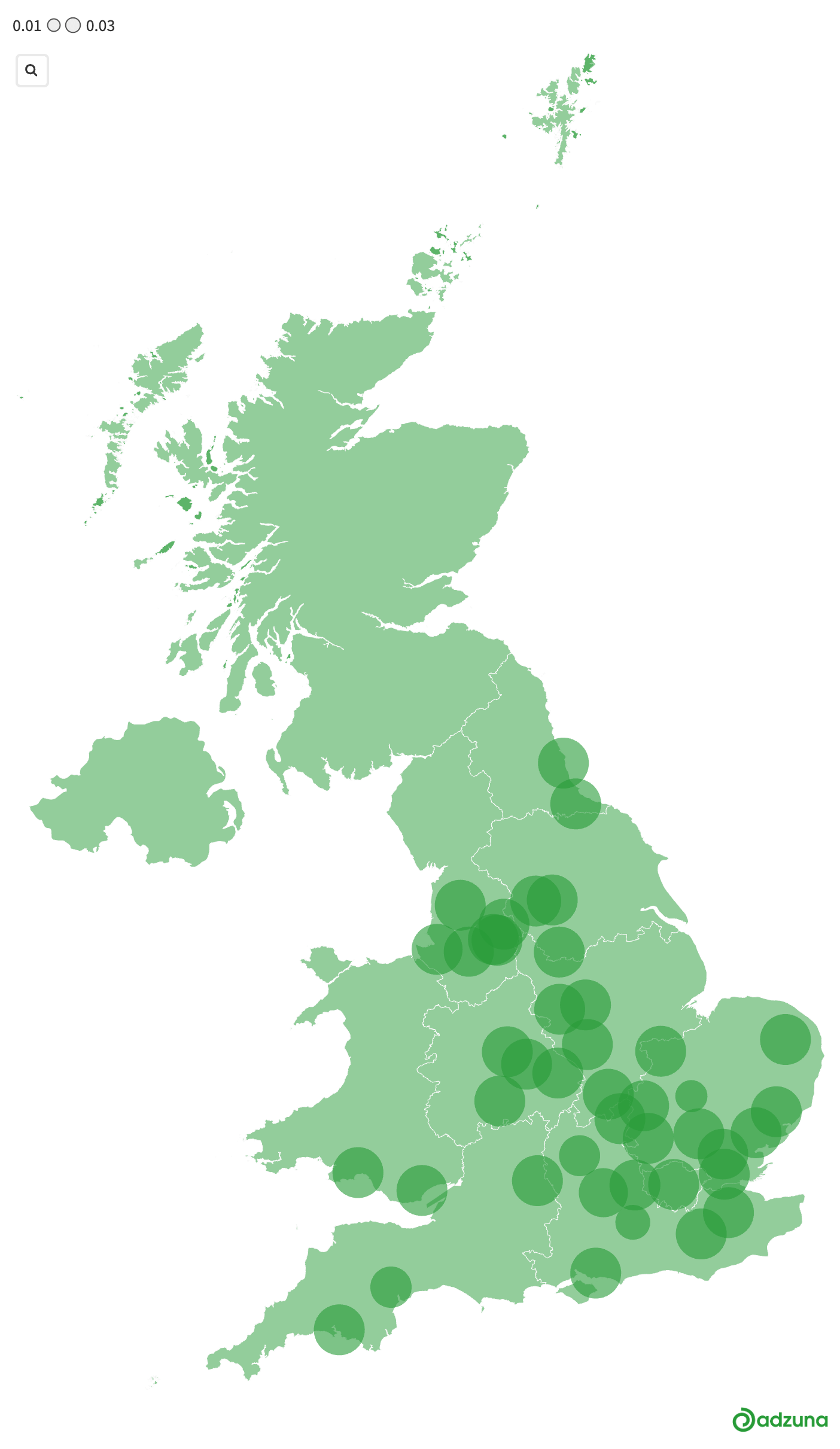
Cambridge remains the top city for job hunters, with the lowest jobseeker to available roles ratio at 0.4, with 6,704 roles available. Guildford comes second with 0.47 and Oxford third with 0.65.
The hardest city to find a role is Bradford, with 9 jobseekers per role, followed by Birmingham (5.23) and Luton (5.1).
UK regions
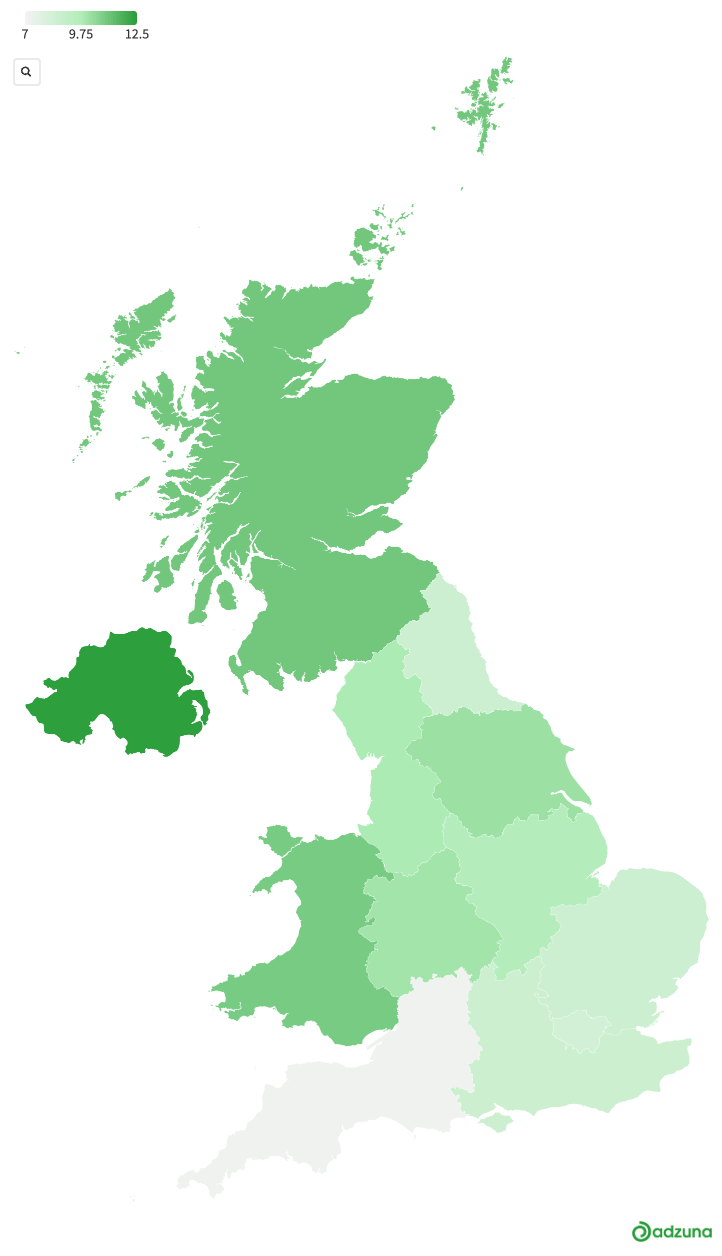
The number of jobseekers per vacancy declined across the majority of UK regions. Only London experienced a minor rise in jobseekers, with 2.29 people competing for each role.
The South West continues to have the smallest jobseeker to vacancy ratio at only 1.36, followed by South East (1.42). In contrast, Northern Ireland had the most competitive market with 3.43 jobseekers per role, followed closely by the North East (3.33) and West Midlands (3.17).

Northern Ireland posted the strongest annual salary growth at +12.38%, pushing the region’s average advertised pay to £40,472, though this may reflect a fall in the number of workers. That makes it one of six UK regions now offering average salaries above £40,000, after South East wages tipped over this threshold for the first time in April. London remains the highest-paying region at £48,635, followed by Eastern England (£40,853).
UK sectors
April brought further momentum in a number of key sectors, offering cautious optimism to jobseekers across the UK. Hospitality & Catering (+5.6%), Logistics & Warehouse (+4.62%), Property (+2.32%), Healthcare & Nursing (+1.94%), Teaching (+1.71%), and Retail (+1.38%) each posted gains, underlining continued demand in care-related and consumer-facing industries.
However, not all sectors shared the growth. After plummeting -17.3% in March, Graduate roles fell a further -7.6% in April, marking a yearly decline of -22.8%. The sectors offering the biggest graduate openings in April are Customer Services (2,823 jobs), Teaching (2,664 jobs), IT (1,681 jobs), and Healthcare & Nursing (634 jobs).
Trade & Construction saw the largest monthly fall in vacancies (-15.18%), nevertheless, the sector recorded the strongest year-on-year growth (+49.75%) across all sectors.
Annually, eight other sectors saw increases, with Teaching (+37.24%), Social Work (+22.46%), and Legal (+16.88%) seeing the strongest growth. Other losses were felt across Retail (-39.4%), Energy, Oil & Gas (-33.65%), IT (-23.21%) and PR, Advertising & Marketing (-22.7%), which each saw the sharpest annual declines.
Since the Autumn budget announcement on National Insurance contributions increase in October 2024, several sectors experienced a sharp decline in job postings, with Retail vacancies down -38.99% alongside Logistics & Warehouse (-21.56%), and Scientific & QA (-16.62%). On the other hand, Trade and Construction and Healthcare & Nursing vacancies grew +37.68% and +20.63% compared to October 2024, respectively.

Salaries continued to rise across most sectors. Teaching led monthly wage growth at +2.74%, followed by Domestic Help & Cleaning (+1.39%). Annual pay growth remained strongest in Logistics & Warehouse (+20.41%), Maintenance (+16.86%), and Teaching (+13.81%). Only a handful of sectors saw month-on-month salary dips, including Travel (-5.4%) and Sales (-0.96%). Legal salaries fell -0.62% from last year, continuing the trend of annual declines in an otherwise high-paying profession.

In terms of hiring speed, Legal and Admin roles remain the quickest to fill, taking an average of just over 31 days. At the other end of the spectrum, roles in Energy, IT, and Consultancy continue to take the longest to secure new hires – often upwards of 38 days, highlighting ongoing challenges in sourcing specialist talent.

Trending jobs
Healthcare Support Worker topped Adzuna’s Trending Roles list for the fifth consecutive month in April. Warehouse Worker and Social Care Worker continued to be the second and third trending role. This ranking is based on the Interest Quotient, a metric that tracks how often job postings are viewed relative to other occupations. A higher quotient reflects a stronger interest among jobseekers.
Cleaner and Healthcare Assistant rounded out the top five, while Administrator and Assistant roles held steady in the middle of the pack – reflecting consistent interest in accessible admin and support positions. Retail Sales Adviser returned to the list in eighth place, while Sales Assistant and Delivery Driver completed the top 10.
Project Manager, which appeared in February and tied for tenth in March, has now dropped out of the rankings. The exit of white-collar roles like Project Manager and Software Developer – which previously made brief appearances – suggests jobseeker focus is shifting back toward frontline and entry-level roles across healthcare, retail, logistics, and support services. The appearance of customer-facing and entry-level roles in the top 10 suggests a growing appetite for stable, accessible jobs across sectors like retail and admin support.

Methodology
About Adzuna
Adzuna is a smarter, more transparent job search engine used by tens of millions of visitors per month. We love using the awesome power of technology to bring together every job in one place, help match people to better, more fulfilling jobs and keep Britain working.
Adzuna supplies real-time data to the Number 10 Dashboard, the Cabinet Office and Office for National Statistics labour market indices. In 2018, Adzuna won the contract to run Find a job, one of the British government’s most used online services.
Adzuna.co.uk was founded in 2011 by Andrew Hunter and Doug Monro, formerly of eBay, Gumtree, Qype and Zoopla and is backed by leading Venture Capital firms LocalGlobe, Index Ventures and Smedvig Capital.
We’ve spent a decade developing smarter, more transparent job search so jobseekers worldwide (we’re in 19 countries) can zero in on the right role faster.
About the Job Market Report
Adzuna has the most complete index of UK job vacancies covering all regions in the UK. The technology collects every job vacancy advertised online in the UK from over 1,000 sources. This data is then normalised, de-duplicated, mix-adjusted and outliers are removed in real time to give users an accurate, complete, up to the minute view of the job market.
Claimant count data is based on the latest Labour Market Statistics released by the ONS. The city areas referred to in this study are the top 50 cities in the UK, ranked by comparing the job vacancies in Adzuna’s comprehensive search index of over 1,000,000 live jobs to the number of claimants in each city from the latest ONS data. The full Jobseeker’s Allowance claimant count statistics are available for download here: www.nomisweb.co.uk.
The interest quotient for key roles is calculated by comparing how many views job postings for different occupations on Adzuna receive over a given month and comparing this to the overall job posting views over the same period. It provides a proxy for talent supply in the jobs market.
For more granular data breakdowns at a local authority level, job title, or skill level, please contact our labour market intelligence division, Adzuna Intelligence.