
UK Job Market Report
30 April 2026


Adzuna has the most complete index of UK job vacancies covering all regions in the UK, based on every job vacancy advertised online in the UK from over 1,000 sources. This data is then normalised, de-duplicated, mix-adjusted and outliers are removed in real time to give an accurate, complete, up to the minute view of the job market. Our UK Job Market Report tracks advertised vacancies, average advertised salaries, competition for jobs, trending roles, time to fill positions, and more.
We also supply real-time data to the Number 10 Dashboard, the Cabinet Office and the Office for National Statistics’ labour market indices. For more granular data breakdowns at a local authority level, job title, or skill level, please contact our labour market intelligence division, Adzuna Intelligence.
Vacancies
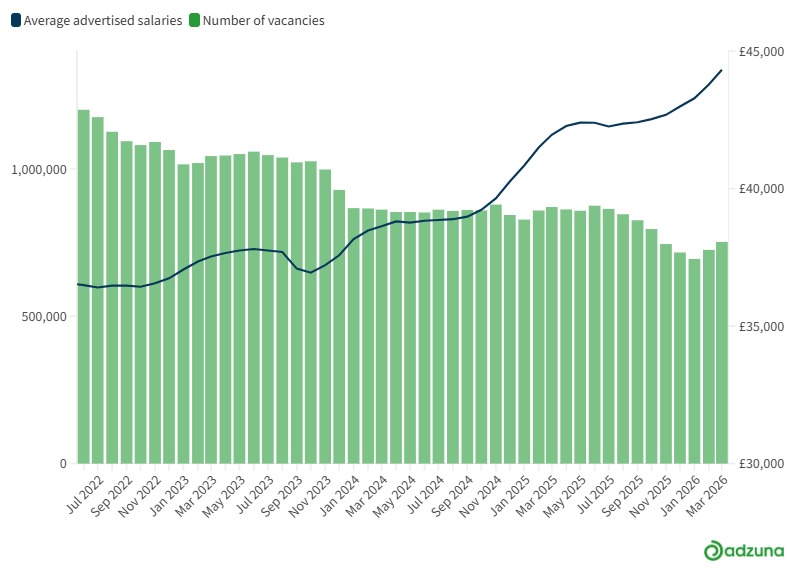
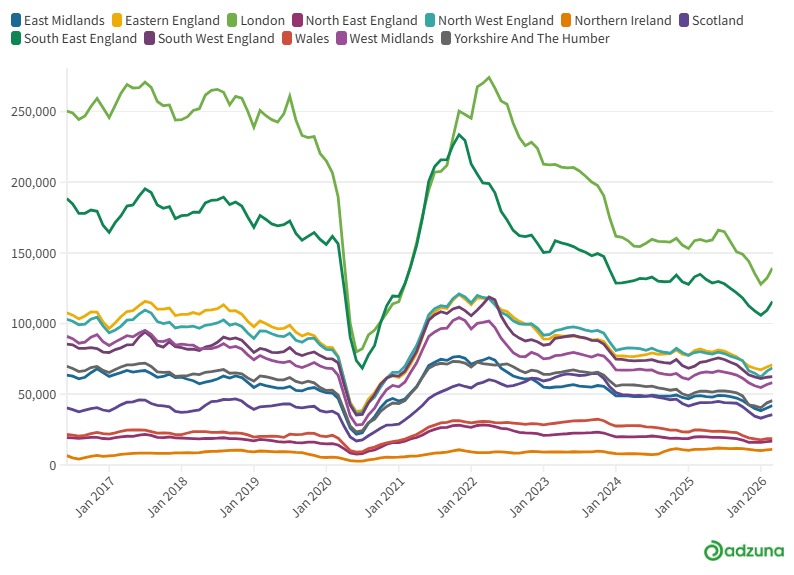
UK job vacancies showed signs of recovery in March, rising +3.74% month-on-month to 752,711 – marking the second consecutive monthly increase after an extended period of decline. Yet despite this tentative rebound, the overall picture remains challenging for job seekers. Vacancies are still -13.60% lower than March 2025, and the market continues to operate near its weakest level since 2021.
The backdrop is significant. April’s National Insurance increase for employers and the rise in the National Living Wage have added to hiring costs, with many businesses absorbing these changes cautiously rather than accelerating recruitment. Global trade uncertainty – driven by US tariff policy – has added a further layer of hesitation for employers in export-facing sectors.
Salaries
Wages continue to grow. The average advertised salary reached £44,031 in March, up +0.55% month-on-month and +4.93% year-on-year. This remains above inflation, now running at around 3%, meaning workers seeing pay increases in advertised roles are still gaining in real terms.
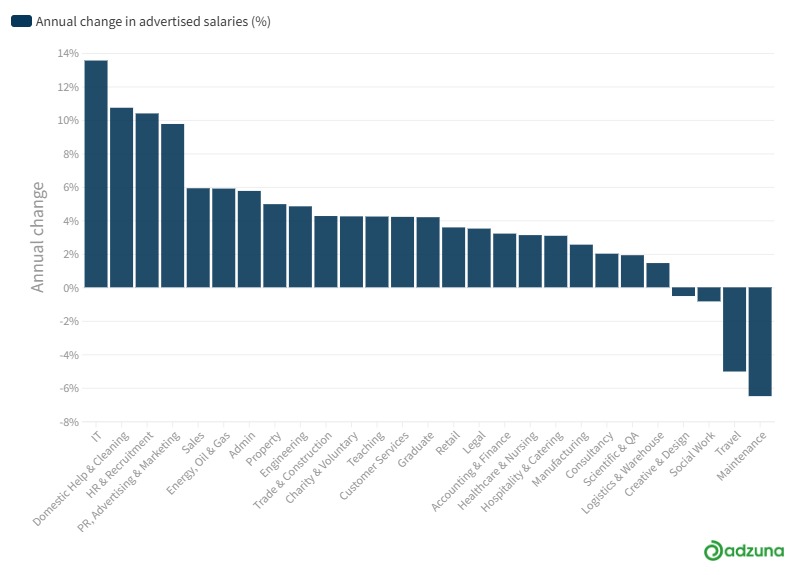
In a landmark moment, London’s average advertised salary broke through £50,000 for the first time – reaching £50,867. IT remains the highest-paid sector nationally, with average salaries of £65,347, up +13.5% annually. Only 4 sectors saw annual salary declines: Maintenance (-6.5%), Travel (-5.0%), Social Work (-0.8%), and Creative & Design (-0.5%).
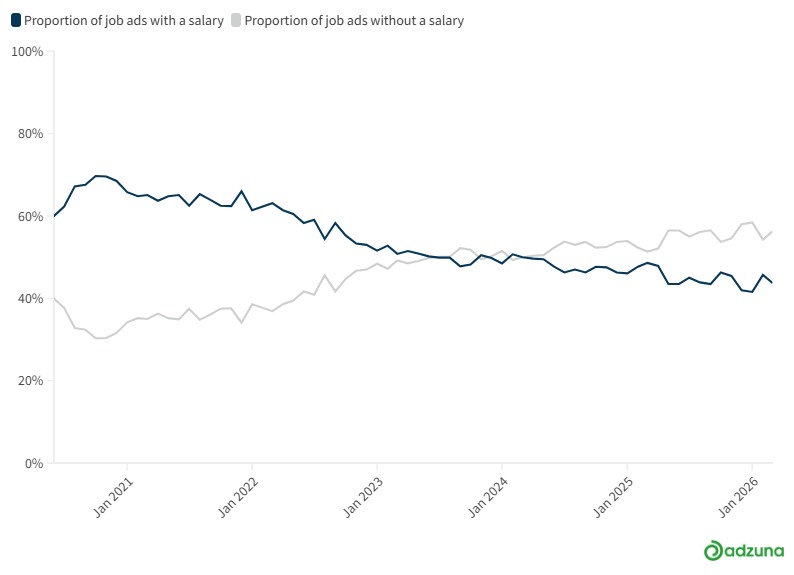
Salary transparency slipped again in March, with just 43.74% of UK job ads including pay details – down from 45.72% in February. This means more than 1 in 2 roles (56.26%) are advertised without salary information, continuing a broadly downward trend that stretches back to 2016.
Time to fill
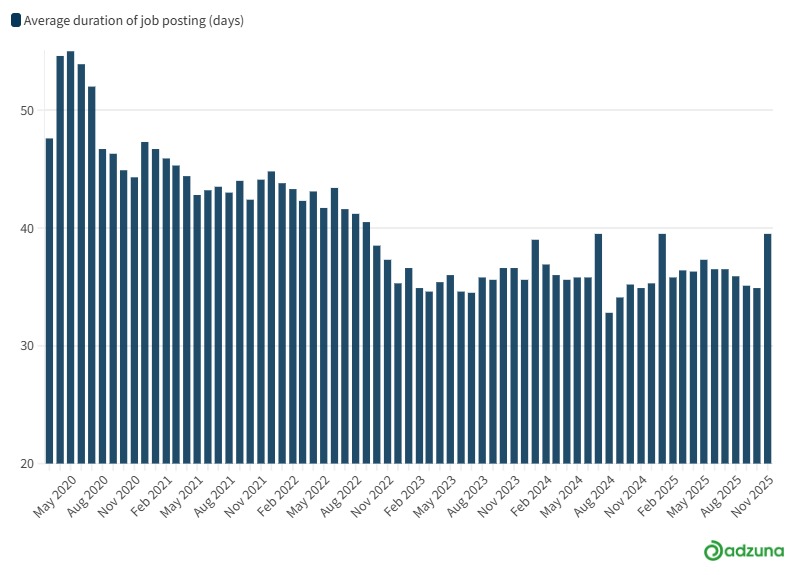
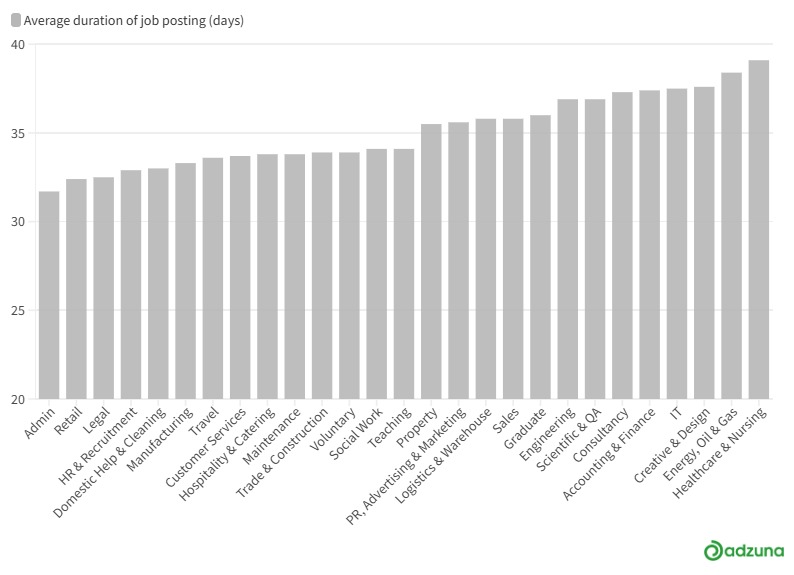
The average time to fill a role fell to 39.5 days from 34.9 days in the previous month. Admin roles continue to fill fastest at 31.7 days, followed by Retail (32.4 days) and Legal (32.5 days). Healthcare & Nursing remained among the slowest sectors to recruit at 39.1 days, alongside Energy, Oil & Gas (38.4 days) and IT (37.5 days).
Competition
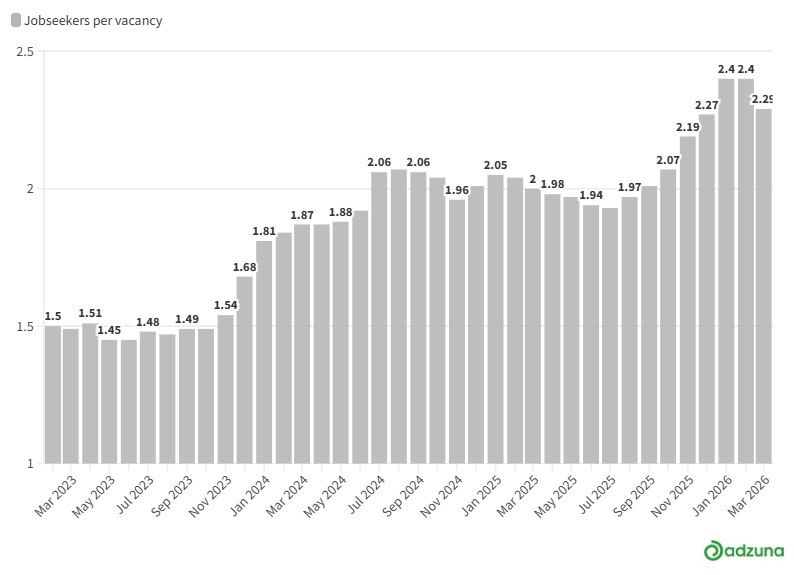
Competition for roles eased marginally in March. The number of jobseekers per vacancy fell to 2.29, down from 2.40 in February – the first improvement since July 2025. However, competition remains well above the 1.81 recorded a year ago, reflecting how sharply the balance of power has shifted toward employers over the past 12 months. ONS data shows unemployment climbed to 4.9% in December 2025 to February 2026, and the estimated number of vacancies decreased by 29,000 (3.9%) to 711,000 in January to March 2026, the lowest level since February to April 2021.
UK regions
London’s average advertised salary reached £50,867 in March – the first UK region to cross the £50,000 mark. Wales posted the strongest annual salary growth at +7.60%, continuing a run of above-average wage increases stretching back over a year. Scotland (+6.29%) and South East England (+5.53%) also recorded strong annual growth.
On vacancies, most regions saw monthly increases in March, with London leading the recovery. Northern Ireland was the only region to record annual vacancy growth, up +0.27% year-on-year, against a backdrop of decline everywhere else.
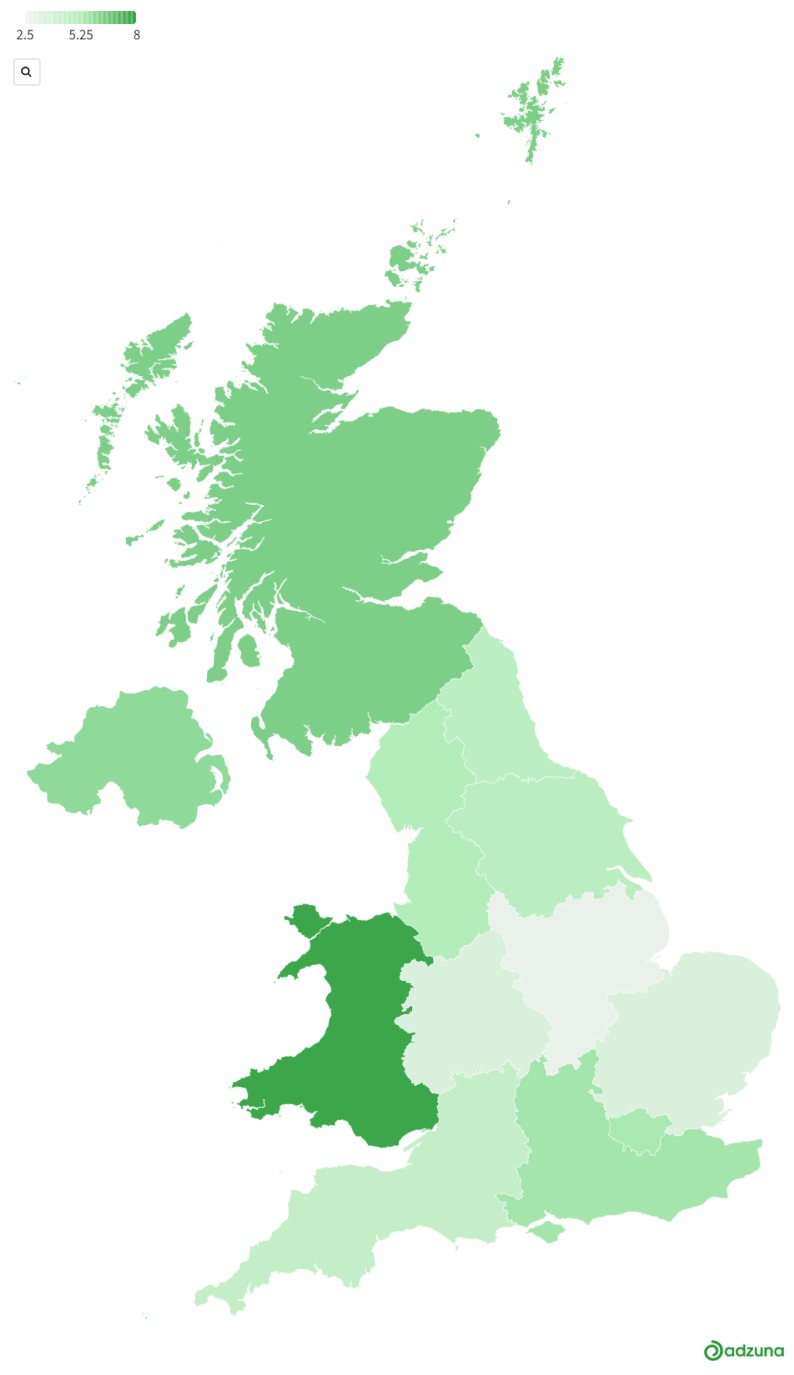
The North East remains the toughest region for job seekers, with 3.82 jobseekers per vacancy – the highest in the UK. Wales (3.56) and the West Midlands (3.51) follow closely. The South West continues to offer the most favourable conditions for candidates, with just 1.64 jobseekers per vacancy, ahead of the South East (1.65) and Eastern England (1.90).
UK sectors
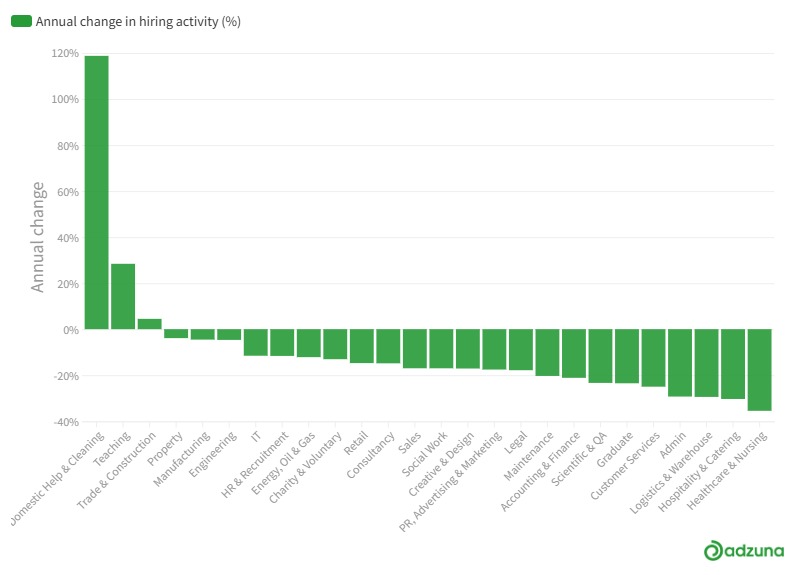
Teaching led the monthly recovery, with vacancies up +8.97% to over 210,000 – by far the largest sector on Adzuna and now +28.4% higher year-on-year. However, with average salaries at £37,309 – below the national average — the data suggests schools are struggling to attract talent at current pay levels. Domestic Help & Cleaning also saw exceptional monthly growth, up +25.95%, continuing a dramatic rise since October 2025 that coincides with National Living Wage changes and growing demand for home-based care.
At the other end of the spectrum, Consultancy dropped -8.08% monthly, while Healthcare & Nursing (-35.5% annually) and Logistics & Warehouse (-29.4% annually) remain two of the hardest-hit sectors on a year-on-year basis.
Graduate vacancies fell -1.2% month-on-month to 10,667 in March, down -34.9% year-on-year and close to the record low of 9,336 set in January 2026. Entry-level vacancies told a more encouraging story, rising +2.4% to 225,634 – the highest level in the dataset.
The proportion of young people aged 16-24 not in education, employment, or training (NEETs) rose to 957,000, remaining a record highs, representing 12.8% of all young people in this age group – in October to December 2025, up from 946,000 the previous quarter.
IT remains the highest-paid sector, with average salaries of £65,347 and the strongest annual growth at +13.5%. Legal (£56,296) and Trade & Construction (£54,552) follow as the second and third highest-paid sectors. Despite falling vacancies, graduate pay rose +4.19% annually to £30,748. Creative & Design saw the steepest monthly salary fall at -2.5%, while Maintenance recorded the largest annual pay decline at -6.5%.
Domestic Help & Cleaning remains the lowest-paid sector at £30,303 – though annual salary growth of +10.7% means it is closing the gap with other sectors, having only crossed the £30,000 mark in recent months.
Admin roles remain the quickest to recruit for, with vacancies filled in an average of 31.7 days, followed by Retail (32.4 days) and Legal (32.5 days). At the other end of the scale, Healthcare & Nursing takes the longest to fill at 39.1 days, followed by Energy, Oil & Gas (38.4 days) and IT (37.5 days).
Methodology
About Adzuna
Adzuna is a smarter, more transparent job search engine used by tens of millions of visitors per month. We love using the awesome power of technology to bring together every job in one place, help match people to better, more fulfilling jobs and keep Britain working.
Adzuna supplies real-time data to the Number 10 Dashboard, the Cabinet Office and Office for National Statistics labour market indices. In 2018, Adzuna won the contract to run Find a job, one of the British government’s most used online services.
Adzuna.co.uk was founded in 2011 by Andrew Hunter and Doug Monro, formerly of eBay, Gumtree, Qype and Zoopla and is backed by leading Venture Capital firms LocalGlobe, Index Ventures and Smedvig Capital.
We’ve spent a decade developing smarter, more transparent job search so jobseekers worldwide (we’re in 19 countries) can zero in on the right role faster.
About the Job Market Report
Adzuna has the most complete index of UK job vacancies covering all regions in the UK. The technology collects every job vacancy advertised online in the UK from over 1,000 sources. This data is then normalised, de-duplicated, mix-adjusted and outliers are removed in real time to give users an accurate, complete, up to the minute view of the job market.
Claimant count data is based on the latest Labour Market Statistics released by the ONS. The city areas referred to in this study are the top 50 cities in the UK, ranked by comparing the job vacancies in Adzuna’s comprehensive search index of over 1,000,000 live jobs to the number of claimants in each city from the latest ONS data. The full Jobseeker’s Allowance claimant count statistics are available for download here: www.nomisweb.co.uk.
The interest quotient for key roles is calculated by comparing how many views job postings for different occupations on Adzuna receive over a given month and comparing this to the overall job posting views over the same period. It provides a proxy for talent supply in the jobs market.
For more granular data breakdowns at a local authority level, job title, or skill level, please contact our labour market intelligence division, Adzuna Intelligence.